Plizio Visual Lab
Nebojša Tower
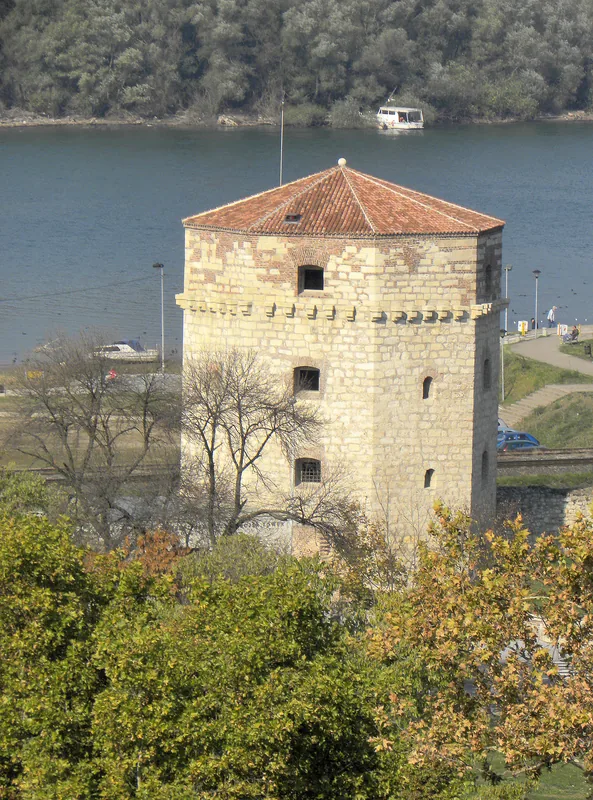
The Nebojša Tower (Kula Nebojša) is the best-preserved medieval structure of the Belgrade Fortress, located in the Lower Town at the edge of the Sava River. Built around 1460 by the Hungarians, the tower was designed as a cannon tower to defend the harbor from Ottoman naval incursions. Its robust circular architecture featured thick walls and specialized embrasures for early artillery, representing the cutting edge of 15th-century military engineering. The name 'Nebojša' translates to 'Fearless', a title inherited from an older, destroyed donjon in the Upper Town. Following the Ottoman conquest of Belgrade in 1521, the tower was repurposed into a notorious dungeon for political prisoners. Its most famous captive was the Greek revolutionary and poet Rigas Feraios, who was executed here in 1798. After a comprehensive restoration completed in 2011 with Greek financial support, the tower now serves as a multi-level museum. The exhibits focus on the history of the fortress and the diverse struggles for liberation across the Balkan Peninsula.
- Location: Serbia
- Nearby: Zemun (5 km)
Best time to visit & climate
The most pleasant time to visit is Jun, Aug, Sep.
| Jan | Feb | Mar | Apr | May | Jun | Jul | Aug | Sep | Oct | Nov | Dec | |
|---|---|---|---|---|---|---|---|---|---|---|---|---|
| Avg °C | 0 | 2 | 7 | 13 | 18 | 22 | 24 | 24 | 19 | 13 | 7 | 1 |
| Rain mm | 48 | 46 | 50 | 50 | 78 | 83 | 63 | 55 | 56 | 54 | 47 | 47 |
📋 Practical info
Geography
Facts
- The tower stands 19 meters high and has a circular floor plan.
- Its walls are between 2.8 and 3.5 meters thick at the lower levels.
- Rigas Feraios, a pioneer of the Greek War of Independence, died here in 1798.
- The tower was originally part of a water-gate system that controlled harbor access.
- A permanent exhibition on the Greek revolutionary movement occupies the second floor.
- The tower's name comes from the Serbian phrase 'ne boj se', meaning 'don't fear'.
Explore nearby
Notable places around
Route planner — Car & Motorhome
Where do you start? We build the route here, with stops and country notes along the way.
© OpenStreetMap contributors · OpenRouteService
Sights nearby
Frequently asked questions
What is the Nebojša Tower?
What does the name mean?
Did the tower serve as a prison?
Who was the most famous prisoner?
Is the tower a museum today?
Nebojša Tower: where is it located?
Nebojša Tower: when is the best time to visit?
Nebojša Tower: why is it worth visiting?

Nearby cities
History & landmarks
Nature
More places