Plizio Visual Lab
Sebilj Fountain
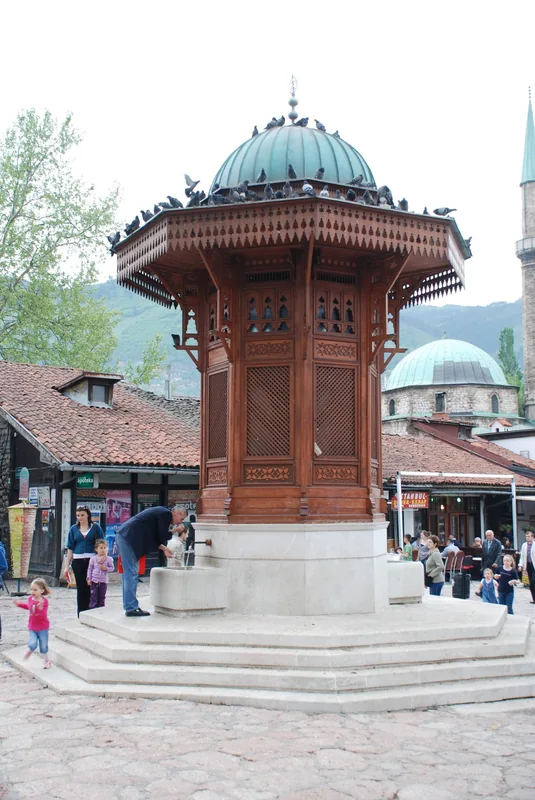
The Sebilj Fountain is undoubtedly the most recognizable symbol of Sarajevo and the beating heart of the historic Baščaršija square. Built in the traditional Ottoman style, it is an elaborately decorated, wood-paneled kiosk fountain. The original Sebilj was endowed in 1753 by the wealthy vizier Mehmed Pasha Kukavica and stood a few meters from the current location before being destroyed in a devastating fire in 1852. The distinctive octagonal pavilion we admire today was designed in 1891 by the Czech architect Alexander Wittek during the Austro-Hungarian period, utilizing a Pseudo-Moorish architectural style. The term 'Sebilj' derives from Arabic, referring to a public building where an official (the sebiljdžija) once dispensed free drinking water to thirsty travelers. Today, the plaza surrounding the fountain, often affectionately called 'Pigeon Square,' is the most popular gathering spot for both locals and tourists.
- Location: Bosnia and Herzegovina
- Top sights: Čekrekčijina · Baščaršijska džamija · Museum of the Old Serbian Orthodox Church Sarajevo
- Nearby: East Sarajevo (6 km)
Best time to visit & climate
The most pleasant time to visit is Jun–Aug.
| Jan | Feb | Mar | Apr | May | Jun | Jul | Aug | Sep | Oct | Nov | Dec | |
|---|---|---|---|---|---|---|---|---|---|---|---|---|
| Avg °C | -2 | -1 | 2 | 7 | 12 | 16 | 18 | 18 | 13 | 9 | 4 | -1 |
| Rain mm | 63 | 64 | 69 | 69 | 99 | 103 | 75 | 61 | 77 | 71 | 74 | 73 |
📋 Practical info
Geography
Facts
- The current fountain was designed in 1891 by architect Alexander Wittek.
- It is a replica of the original 18th-century fountain.
- The term 'Sebilj' comes from Arabic, meaning 'way' or 'path'.
- It was built in the pseudo-Moorish style popular in the late 19th century.
- Legend has it that whoever drinks from the fountain will return to Sarajevo.
- It stands in the center of Baščaršija Square, the heart of the Old Town.
- A replica was gifted to the Serbian city of Novi Pazar in 2018.
Explore nearby
Notable places around
Route planner — Car & Motorhome
Where do you start? We build the route here, with stops and country notes along the way.
© OpenStreetMap contributors · OpenRouteService
Sights in the town Sebilj Fountain (10)
Old Orthodox Church
16th-century Serbian Orthodox church in Sarajevo's old town.
City Hall
Ornate 1896 building in Moorish style, now the national library.
Gazi Khusrev-beg's Khanqa
Former dervish monastery from the 16th century in Sarajevo.
Ars Aevi
Contemporary art center with an international collection.
Careva ćuprija
Stone bridge over the Miljacka river, built in the 16th century.
Gazi Husrev Bey's (Kuršumli) Madrasa
Ottoman Quranic school built in 1537, now a cultural monument.
Sights nearby
Frequently asked questions
Can I drink the water from the fountain?
Why are there so many pigeons there?
When was the fountain built?
Is there parking nearby?
Is the square illuminated at night?
Sebilj Fountain: where is it located?
Sebilj Fountain: what is there to see?
Sebilj Fountain: when is the best time to visit?
Sebilj Fountain: why is it worth visiting?
Nearby cities