Plizio Visual Lab
Ghawar Oil Field
Weather…
Water temperature…
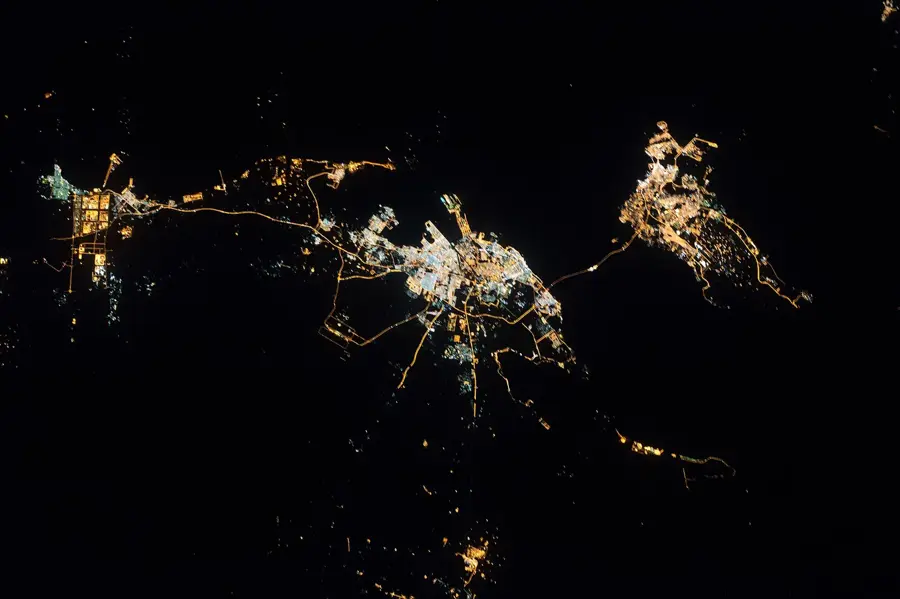
The Ghawar Oil Field in eastern Saudi Arabia is the world's largest conventional onshore oil field and the backbone of global energy supply. Discovered in 1948, it spans an impressive area of approximately 280 by 30 kilometers within the Al-Ahsa Governorate. Since production began in 1951, Ghawar has accounted for more than half of the cumulative oil ever produced in Saudi Arabia. Operated by Saudi Aramco, the field is divided into six production areas, with the northern sections (Ain Dar and Shedgum) being the most prolific. The geological formations at Ghawar consist primarily of highly porous carbonate rock, which facilitates efficient extraction. Despite decades of intensive exploitation, the field still holds enormous reserves. Sustaining production rates requires sophisticated techniques, such as massive seawater injection to maintain reservoir pressure. As a strategic asset of immeasurable value, Ghawar significantly influences global oil prices and the geopolitical stability of the energy market.
- Location: Saudi Arabia
- Nearby: Al Hofuf (9 km)
Best time to visit & climate
The most pleasant time to visit is Feb, Mar, Nov.
| Jan | Feb | Mar | Apr | May | Jun | Jul | Aug | Sep | Oct | Nov | Dec | |
|---|---|---|---|---|---|---|---|---|---|---|---|---|
| Avg °C | 14 | 17 | 22 | 27 | 33 | 36 | 38 | 37 | 34 | 29 | 22 | 16 |
| Rain mm | 5 | 5 | 3 | 4 | 0 | 0 | 0 | 0 | 0 | 1 | 7 | 7 |
📋 Practical info
Geography
Facts
- Ghawar was discovered in 1948 and commercial production started in 1951.
- The field measures approximately 280 km in length and up to 30 km in width.
- It produces roughly 3.8 million barrels of crude oil per day (as of 2019).
- The field is partitioned into six sectors: Fazran, Ain Dar, Shedgum, Uthmaniyah, Hawiyah, and Haradh.
- It also provides a substantial volume of associated natural gas.
- Estimated remaining reserves exceed 48 billion barrels of oil.
Explore nearby
Notable places around

Route planner — Car & Motorhome
Where do you start? We build the route here, with stops and country notes along the way.
© OpenStreetMap contributors · OpenRouteService
Sights nearby
Frequently asked questions
Why is the Ghawar oil field famous?
Is the oil field accessible to tourists?
How large is the field?
What does the field mean for the global economy?
Are there settlements directly on the field?
Ghawar Oil Field: where is it located?
Ghawar Oil Field: when is the best time to visit?
Ghawar Oil Field: why is it worth visiting?

Nearby cities
History & landmarks
Nature
More places