Plizio Visual Lab

Moray
Plizio editorial teamData Sources
Landmark
—°8
Moray (Peru)

Weather…

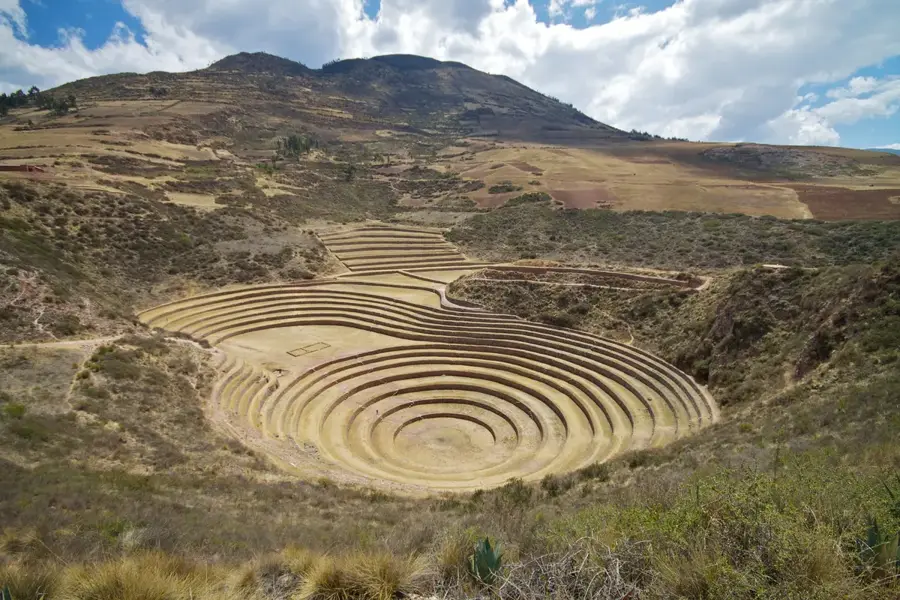
Moray is one of the most enigmatic and visually striking Inca sites, consisting of several massive circular terraces that resemble a giant amphitheater. Located on a high plateau in the Sacred Valley, these concentric terraces are believed to have been a sophisticated agricultural laboratory. Each level of the terraces has its own microclimate, with a temperature difference of up to 15 degrees Celsius between the top and the bottom, mimicking various ecological zones across the Inca Empire. Here, Inca scientists likely experimented with different crops and seeds to determine the best conditions for their growth. The precision of the engineering, including the drainage system that prevents flooding even during heavy rains, is a testament to the Incas' deep knowledge of ecology and agriculture.

Best time to visit & climate

The most pleasant time to visit is May, Aug, Sep.

JanFebMarAprMayJunJulAugSepOctNovDec
Avg °C998888789999
Rain mm129127964494118186372137

📋 Practical info

🚪
Visiting
Moray is an Inca archaeological site that can be visited for a small entrance fee. Visitors can view the circular terraces from above and also walk down into them.
🕒
Typical hours
The site is typically open daily from morning until late afternoon, with exact hours varying by season. Visiting early in the morning is recommended to avoid crowds.
📷
Photography
Photography is allowed throughout the site, but drones are not permitted. The best shots are from the upper viewing platform or from the center of the circles.
⏱️
Time needed
Allow about 1 to 1.5 hours for a thorough visit, including the terraces and viewpoints. Those interested in Inca agriculture may stay longer.
Combine with
Moray is close to the Maras salt flats and the Inca town of Chinchero; these can be combined in one day. The Sacred Valley of the Incas provides many other sights.
🧭
Getting there
Moray is about 50 km northwest of Cusco and is best reached by car or organized tour. Public buses go to the nearby town of Maras, from where you can take a taxi.
💡
Insider tip
Visit Moray late in the morning when the sunlight best highlights the terraces. Bring sun protection and altitude medication as the site is above 3,500 meters.

Geography

Coordinates
-13.32970, -72.19750

Facts

  • Consists of three large circular depressions, the largest being over 30 meters deep.
  • Designed to simulate different ecological zones, from the coast to the highlands.
  • The site features a sophisticated irrigation system that kept each terrace hydrated.
  • The temperature difference between levels allowed for testing over 250 different plant species.
  • Believed to be a key reason for the Incas' success in achieving food security.
  • The perfect circular shapes were carved into a natural depression in the earth.
  • Despite heavy rains, the lowest level of the terraces never floods due to excellent drainage.
  • Located at an altitude of 3,500 meters, near the village of Maras.

Explore nearby

Notable places around
Route planner — Car & Motorhome

Where do you start? We build the route here, with stops and country notes along the way.

Vehicle
Only stops with (optional):

© OpenStreetMap contributors · OpenRouteService

Sights in the town Moray (8)

Museo de la Chicha Yola🏛 museum

A cultural museum dedicated to the history and brewing process of chicha, the traditional Andean fermented corn beverage.

Simamuyu🏺 historical

Pre-Columbian archaeological ruins characterized by their distinctive circular Andean stonework.

K'uychi Muyu🏺 historical

Ancient stone ruins reflecting the region's historic Inca agricultural or residential architecture.

Q'echuyuq Muyu🏺 historical

An archaeological site preserving the circular architectural layouts typical of certain regional ancient settlements.

Centro Cultural Vidawasi🎭 culture

A modern arts and cultural center focused on promoting Andean community health, heritage, and creativity.

Balancín📍 landmark

A recreational swing attraction offering riders sweeping views over the surrounding Sacred Valley landscape.

Salineras de Maras📍 landmark

Thousands of terraced salt evaporation ponds fed continuously by a highly salty subterranean spring.

🕒 Mo-Su 06:00-18:00

Templo de Tiobamba📍 landmark

A distinctive colonial-era Catholic church built from adobe and stone in the rural Maras region.

🕒 10:00-14:00

Sights nearby

Frequently asked questions

What exactly are the Moray terraces?
They were agricultural experimental sites of the Incas.
Is it a long way to get there?
About 1.5 to 2 hours by car from Cusco.
Is it very windy there?
Yes, due to the location it can be very windy, bring a jacket.
Can you descend into the terraces?
Yes, you can use the stairs to get to the center.
Is a ticket required?
Yes, it is usually part of the 'Boleto Turístico'.
Moray: where is it located?
Moray is located in Peru.
Moray: what is there to see?
Highlights include Museo de la Chicha Yola, Simamuyu, K'uychi Muyu.
Moray: when is the best time to visit?
The most pleasant time to visit is May, Aug, Sep.
Moray: why is it worth visiting?
Moray is one of the most enigmatic and visually striking Inca sites, consisting of several massive circular terraces that resemble a giant amphitheater.
View on map → The Top 50 Attractions → OpenStreetMap →
South America
Explore with Plizio Discover more places in South America
More places in Peru →

Nearby cities

History & landmarks
Nature

More places