Plizio Visual Lab
Pont du Gard
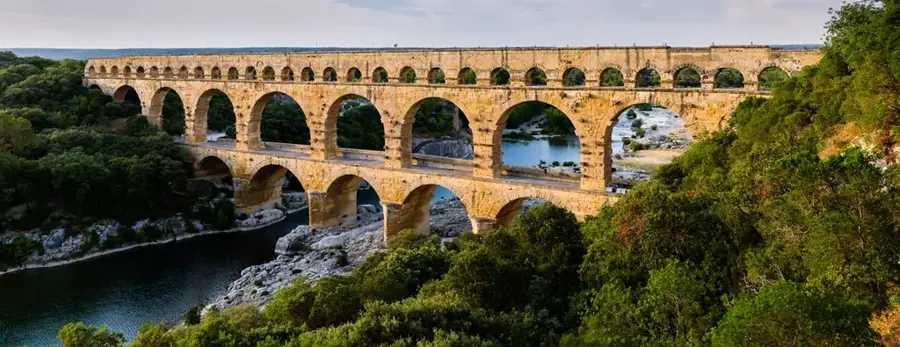
The Pont du Gard is one of the best-preserved Roman aqueduct bridges in the world and a supreme masterpiece of ancient engineering. Built in the 1st century AD, it was part of a 50-kilometer long aqueduct system designed to carry water from springs near Uzès to the Roman colony of Nîmes. Standing 48.8 meters high above the Gardon River, it is the tallest bridge ever constructed by the Romans. The structure consists of three tiers of arches, built using precisely cut blocks of stone that fit together without the use of mortar. Remarkably, the entire aqueduct drops only 12 meters in height over its 50-kilometer length, demonstrating the incredible mathematical precision of its builders. In 1985, the bridge was designated a UNESCO World Heritage site for its historical and architectural significance. Today, the Pont du Gard is one of France's most popular landmarks, featuring a modern visitor center that details the construction techniques used. The surrounding Mediterranean landscape also gives opportunities for hiking and kayaking beneath the monumental ancient arches.
- Location: Occitanie, France
- Top sights: Artiste en Arts visuels · Église Saint-Gérard · Château de Bosc
- Nearby: Rochefort-du-Gard (4 km)
Best time to visit & climate
The most pleasant time to visit is Jun, Aug, Sep.
| Jan | Feb | Mar | Apr | May | Jun | Jul | Aug | Sep | Oct | Nov | Dec | |
|---|---|---|---|---|---|---|---|---|---|---|---|---|
| Avg °C | 4 | 5 | 9 | 13 | 17 | 22 | 25 | 24 | 20 | 15 | 9 | 5 |
| Rain mm | 61 | 48 | 54 | 69 | 65 | 42 | 30 | 36 | 65 | 106 | 104 | 61 |
📋 Practical info
Geography
Facts
- Built in the 1st century AD
- Stands 48.8 meters high
- UNESCO World Heritage site since 1985
- Part of a 50km long aqueduct
- Stones weigh up to 6 tons each
- Three tiers with 6, 11, and 35 arches
Explore nearby
Notable places around
Route planner — Car & Motorhome
Where do you start? We build the route here, with stops and country notes along the way.
© OpenStreetMap contributors · OpenRouteService
Sights in the town Pont du Gard (6)
Château de Saze🏰 castle
Castle in France, a historic building with a park.
Église Saint-Privat
Church in the Gard department, named after Saint Privatus.
Sights nearby
Frequently asked questions
What is the Pont du Gard?
Can you visit the top level?
Can you swim in the river under the bridge?
Is there an entry fee?
Are there restaurants on-site?
Pont du Gard: where is it located?
Pont du Gard: what is there to see?
Pont du Gard: when is the best time to visit?
Pont du Gard: why is it worth visiting?

Nearby cities