Plizio Visual Lab

El Infiernito (Monquirá Archaeological Park)
Plizio editorial teamData Sources
Historical site
—°10
El Infiernito (Monquirá Archaeological Park) (Colombia)

Weather…

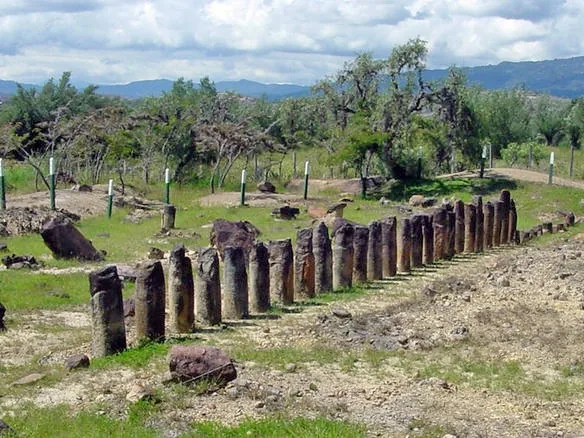
Monquirá Archaeological Park, widely known as "El Infiernito," is a significant pre-Columbian Muisca site located near Villa de Leyva. The site features a series of upright stone monoliths used for both astronomical observations and religious ceremonies. Estimated to be between 2,200 and 2,500 years old, it allowed the Muisca people to precisely determine solstices and equinoxes, which were crucial for their agricultural calendar. The most striking features are the large phallic stone pillars, symbolizing fertility, arranged in distinct rows. Archaeologists have uncovered tombs and various offerings at the site, highlighting its spiritual importance to the indigenous society. The name "El Infiernito" (The Little Hell) was bestowed by Spanish conquerors who viewed the pagan symbols as diabolical. Today, the park serves as an open-air museum, showcasing the advanced astronomical knowledge and spiritual complexity of the Andean indigenous peoples.

Best time to visit & climate

The most pleasant time to visit is Jan, Feb, Dec.

JanFebMarAprMayJunJulAugSepOctNovDec
Avg °C151616161615151515151515
Rain mm436011919219515113212011218016287

📋 Practical info

🚪
Visiting
El Infiernito (Monquirá Archaeological Park) is a pre-Columbian Muisca site with large phallic stone columns. The park is open to visitors for a small fee, offering a unique astronomical observatory.
🕒
Typical hours
The park is typically open daily from 8:00 a.m. to 5:00 p.m. Hours may vary on holidays; a prior inquiry is advisable.
📷
Photography
Photography is allowed throughout the site, the stone columns making dramatic subjects. Please do not climb on the columns to protect them.
⏱️
Time needed
Viewing the main area with the columns takes about 45 minutes. If you also enjoy the surrounding hills and views, allow one and a half hours.
Combine with
The park is near Villa de Leyva, a beautiful colonial town. Also visit the Fossil Museum and the main square of Villa de Leyva.
🧭
Getting there
El Infiernito is about 7 km from Villa de Leyva, reachable by car, taxi, or bicycle. Parking is available at the entrance.
💡
Insider tip
Visit in the late afternoon when the light highlights the columns' shadows for great photos. Bring a flashlight to explore the small caves in the rocks.

Geography

Coordinates
5.63000, -73.55830

Facts

  • The site is estimated to be approximately 2,200 to 2,500 years old.
  • It contains about 30 large monoliths and over 100 smaller stones.
  • The alignment of the stones correlates with solar cycles and solstices.
  • Located 5 kilometers from the colonial town of Villa de Leyva.
  • It was rediscovered and studied by scientists in the 19th century.
  • The park covers an area of roughly 3,500 square meters.

Explore nearby

Notable places around
Route planner — Car & Motorhome

Where do you start? We build the route here, with stops and country notes along the way.

Vehicle
Only stops with (optional):

© OpenStreetMap contributors · OpenRouteService

Sights in the town El Infiernito (Monquirá Archaeological Park) (10)

Cruz Atrial🏺 historical

The Cruz Atrial is a historic stone cross positioned near the fascinating monolithic ruins of the Monquirá Archaeological Park.

Granja de Avestruces📍 landmark

The Granja de Avestruces is an interactive farm where visitors can closely observe and learn about exotic ostriches in the Andean highlands.

La Candelaria Aquapark🎡 recreation

La Candelaria Aquapark features refreshing swimming pools and water slides set against the dry, sunbaked landscape of the region.

Blue wells📍 landmark

These artificially created pit lakes are famous for their strikingly bright blue waters, tinted by dissolved minerals.

Virgen📍 landmark

A prominent shrine dedicated to the Virgin Mary, offering a quiet place for reflection in the archaeological zone.

Sol Muisca🏛 museum

This museum is dedicated to the astronomical knowledge of the Muisca people, focusing on their solar observations.

Parque Arqueologico🏺 historical

An ancient indigenous site featuring large stone monoliths arranged to serve as a pre-Hispanic calendar.

Museo El Fósil🏛 museum

Built directly over the excavation site, this museum displays an almost complete 120-million-year-old Kronosaurus skeleton.

🕒 Mo-Su 08:00-17:30💶

Museo Paleontológico🏛 museum

This museum houses a rich collection of marine fossils from the Cretaceous period, highlighting the area's history as an ancient sea.

💶

Amonita🏺 historical

A public monument shaped like a giant spiral ammonite shell, celebrating the valley's rich paleontological heritage.

Sights nearby

Frequently asked questions

What does the name "El Infiernito" mean?
It means "The Little Hell," a name given by Spanish conquerors to the indigenous ritual site.
What can you see there?
Large phallic stone statues and an astronomical site of the Muisca culture.
How much is the entrance fee?
The entrance fee is approximately 11,000 COP per person.
Where is El Infiernito located?
About 5 km outside of Villa de Leyva, easily accessible by bike or taxi.
When is the park open?
Usually Tuesday to Sunday from 9:00 AM to 12:00 PM and 2:00 PM to 5:00 PM.
El Infiernito (Monquirá Archaeological Park): where is it located?
El Infiernito (Monquirá Archaeological Park) is located in Colombia.
El Infiernito (Monquirá Archaeological Park): what is there to see?
Highlights include Cruz Atrial, Granja de Avestruces, La Candelaria Aquapark.
El Infiernito (Monquirá Archaeological Park): when is the best time to visit?
The most pleasant time to visit is Jan, Feb, Dec.
El Infiernito (Monquirá Archaeological Park): why is it worth visiting?

Monquirá Archaeological Park, widely known as "El Infiernito," is a significant pre-Columbian Muisca site located near Villa de Leyva.
View on map → The Top 50 Attractions → OpenStreetMap →
South America
Explore with Plizio Discover more places in South America
More places in Colombia →

Nearby cities

History & landmarks
Nature
More places