Plizio Visual Lab

Gemasolar Plant
Plizio editorial teamData Sources
Industrial site
—°1
Gemasolar Plant (Spain)

Weather…

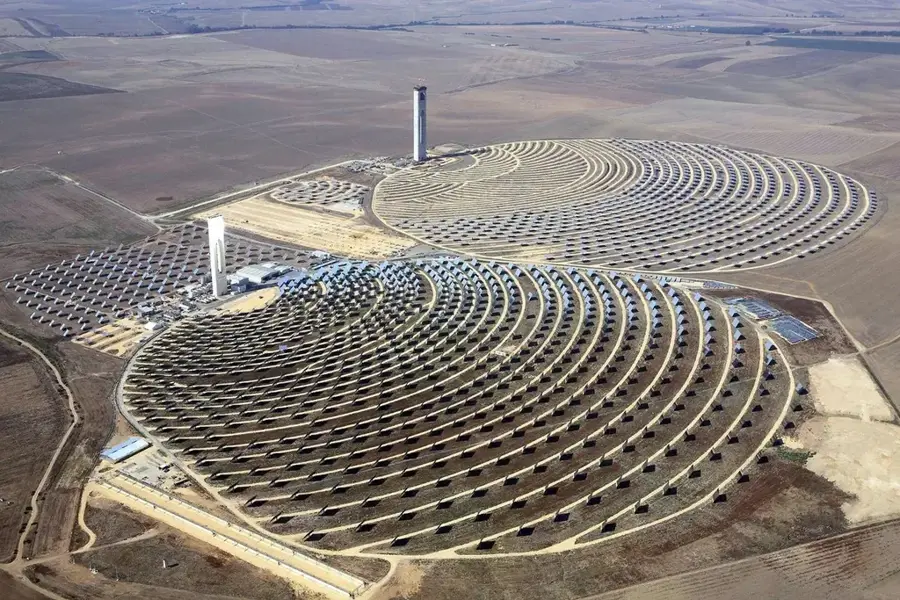
The Gemasolar power plant in the Andalusian province of Seville is a pioneering renewable energy facility and the world's first commercial solar tower power plant to use molten salt as a heat transfer medium and storage system. On a circular area of almost 200 hectares, more than 2,600 huge, computer-controlled mirrors (heliostats) reflect the intensive Andalusian sunlight onto a 140-meter-high central tower. In this receiver, a salt mixture is heated to over 500 degrees Celsius. The revolutionary advantage of this technology lies in its storage capacity: the enormous heat in the molten salt makes it possible to generate steam and drive a turbine even after sunset or on cloudy days. As a result, Gemasolar can continue to operate for up to 15 hours without direct sunlight and supply base-load electricity to thousands of households almost around the clock, solving the biggest problem of conventional solar plants.

Best time to visit & climate

The most pleasant time to visit is May, Jun, Sep.

JanFebMarAprMayJunJulAugSepOctNovDec
Avg °C91013162025292925191310
Rain mm505165543151427727163

📋 Practical info

🏭
What is this place?
The Gemasolar plant is an innovative solar thermal power station that can store energy using molten salt. It is one of the first power plants in the world capable of producing electricity 24/7, a pioneer in renewable energy.
🚪
Visiting
The plant is not normally open to the public, but guided tours or open days are occasionally offered. It is advisable to check for current visitor opportunities in advance.
👀
Where to view it
From the nearby A-4 highway or from the hills of the Sierra de la Carbonera, the plant with its distinctive tower is clearly visible. The best view is from elevated points west of the facility.
🧺
Local products
There are no typical local products from the plant itself; the region is known for olive oil and wine. These agricultural products can be found at farmers' markets.
📆
Active season
The plant operates year-round, with peak electricity production in summer due to higher solar radiation. Thanks to storage, it can also supply power at night.
Nearby
Combine your visit with the nearby town of Fuente de Piedra, known for its lagoon and flamingos. The historic city of Antequera is also worth a detour.

Geography

Coordinates
37.56110, -5.33190

Explore nearby

Notable places around

Route planner — Car & Motorhome

Where do you start? We build the route here, with stops and country notes along the way.

Vehicle
Only stops with (optional):

© OpenStreetMap contributors · OpenRouteService

Sights in the town Gemasolar Plant (1)

Gemasolar Thermosolar Plant📍 landmark

A solar thermal power plant in Spain, using a tower and salt storage to generate electricity from sunlight.

Sights nearby

Frequently asked questions

What is special about Gemasolar?
It is the world's first commercial solar tower plant capable of providing power 24 hours a day.
How does it work at night?
Through a molten salt storage system that stores heat collected during the day.
Where is the plant located?
In Fuentes de Andalucía, near Seville.
Can you visit it?
Direct access for tourists is usually not possible, but it is clearly visible from the highway.
How many mirrors are there?
There are 2,650 heliostats (mirrors) that direct light to the top of the tower.
Gemasolar Plant: where is it located?
Gemasolar Plant is located in Galicia, Spain.
Gemasolar Plant: when is the best time to visit?
The most pleasant time to visit is May, Jun, Sep.
Gemasolar Plant: why is it worth visiting?

The Gemasolar power plant in the Andalusian province of Seville is a pioneering renewable energy facility and the world's first commercial solar tower power plant to use molten salt as a heat transfer medium and storage system.
View on map → The Top 50 Attractions → Most beautiful beaches → OpenStreetMap →
Europe
Explore with Plizio Discover more places in Europe
More places in Spain →

Nearby cities

History & landmarks