Plizio Visual Lab
Pula Arena
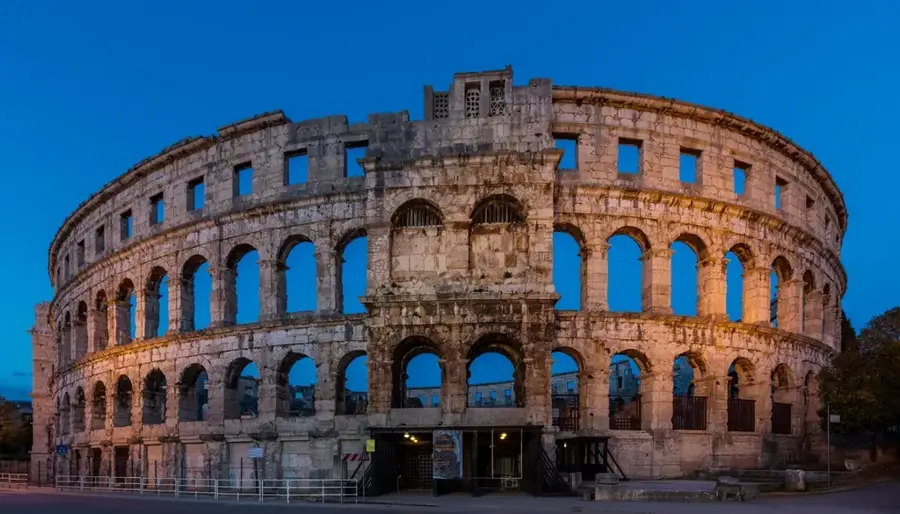
The Pula Amphitheater, widely known as the Arena, is the definitive symbol of the city and one of the six largest surviving Roman amphitheaters in the world. It was constructed during the 1st century AD under the reign of Emperor Vespasian, contemporaneous with the Colosseum in Rome. Built from local limestone, the Arena once accommodated approximately 23,000 spectators who gathered to watch gladiatorial contests and wild animal hunts. It is unique for having all four side towers and all three Roman architectural orders of the exterior walls fully preserved. During the Middle Ages, the structure was occasionally used as a stone quarry until its systematic restoration began in the 19th century. Today, it serves as a major cultural venue, hosting the Pula Film Festival and numerous international concerts. The subterranean passages beneath the arena floor now house an exhibition dedicated to ancient viticulture and olive oil production in Istria.
- Location: Croatia
- Top sights: Pula Amphitheatre · Arena Pula · Valerijin park
- Nearby: Pješčana Uvala (4 km)
Best time to visit & climate
The most pleasant time to visit is Jun, Jul, Sep.
| Jan | Feb | Mar | Apr | May | Jun | Jul | Aug | Sep | Oct | Nov | Dec | |
|---|---|---|---|---|---|---|---|---|---|---|---|---|
| Avg °C | 6 | 6 | 9 | 13 | 17 | 22 | 24 | 24 | 20 | 16 | 11 | 7 |
| Rain mm | 78 | 95 | 74 | 67 | 84 | 64 | 49 | 71 | 113 | 101 | 133 | 102 |
📋 Practical info
Geography
Facts
- The Arena was constructed in the 1st century AD using white local limestone.
- The exterior walls reach a maximum height of approximately 32 meters.
- The ground plan is elliptical, with axes measuring 132 and 105 meters.
- Originally, up to 23,000 spectators could attend the events held here.
- It is the only Roman amphitheater with four side towers fully preserved.
- Since 1954, it has been the venue for the prestigious annual Pula Film Festival.
Explore nearby
Notable places around
Route planner — Car & Motorhome
Where do you start? We build the route here, with stops and country notes along the way.
© OpenStreetMap contributors · OpenRouteService
Sights in the town Pula Arena (10)
Istrian Olive Oil Museum🏛 museum
Museum with guided tastings from 10:00 to 17:00, focused on olive oil.
MEMO Museum of good Memories🏛 museum
Museum about life in former Yugoslavia.
Tito's Park🌳 park
Park in Pula, named after Josip Broz Tito.
Rimski mauzolej
Roman mausoleum in Pula, an archaeological site.
Galerija C8
Gallery in Pula, a space for contemporary art.
Roman Twin gates
2nd-century Roman city gate in Pula, Croatia.
Sights nearby
Frequently asked questions
When was the Pula Arena built?
Are there still gladiator fights today?
Can you visit the underground passages?
How many spectators could fit inside in the past?
Is the Arena still used for events?
Pula Arena: where is it located?
Pula Arena: what is there to see?
Pula Arena: when is the best time to visit?
Pula Arena: why is it worth visiting?

Nearby cities