Plizio Visual Lab
Basilica Cistern
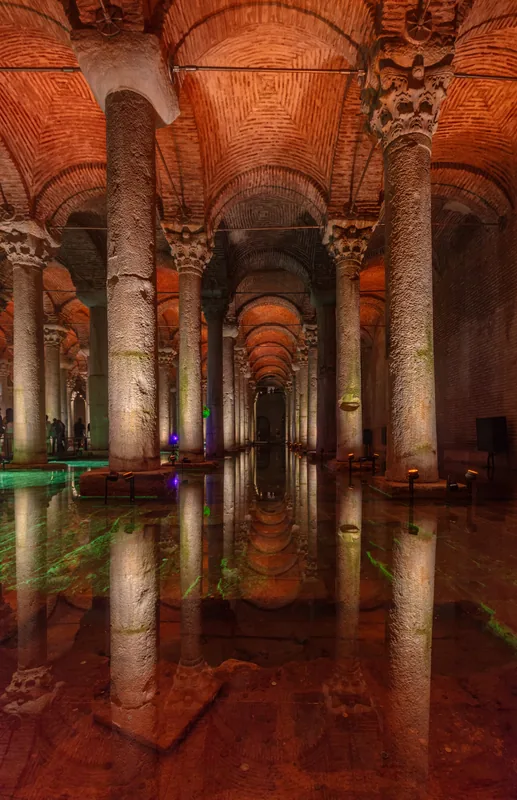
Constructed in the 6th century during the reign of Byzantine Emperor Justinian I, the Basilica Cistern, known as Yerebatan Sarnıcı in Turkish, is the largest surviving ancient water reservoir in Istanbul. The structure measures approximately 138 meters in length and 65 meters in width, covering a total area of nearly 9,800 square meters. It was designed to provide water filtration and storage for the Great Palace of Constantinople and later for the Topkapı Palace, with water supplied through aqueducts from the Belgrade Forest. The ceiling is supported by a forest of 336 marble columns, arranged in 12 rows, most featuring Corinthian or Doric capitals. A notable feature is the pair of Medusa heads used as bases for columns in the northwest corner, likely repurposed from late Roman monuments. Today, the site functions as a major museum, offering visitors a walk through its cool, dimly lit corridors reflecting centuries of history.
- Location: Turkey
- Top sights: Milion · Hacı Beşir Ağa Çeşmesi · Basilica Cistern (Exit)
- Nearby: Caddebostan (8 km)
Best time to visit & climate
The most pleasant time to visit is Jun, Jul, Sep.
| Jan | Feb | Mar | Apr | May | Jun | Jul | Aug | Sep | Oct | Nov | Dec | |
|---|---|---|---|---|---|---|---|---|---|---|---|---|
| Avg °C | 6 | 7 | 9 | 12 | 17 | 22 | 25 | 26 | 22 | 17 | 12 | 8 |
| Rain mm | 79 | 68 | 53 | 42 | 35 | 36 | 20 | 22 | 54 | 70 | 63 | 82 |
📋 Practical info
Geography
Facts
- The cistern has a storage capacity of approximately 80,000 cubic meters of water.
- Construction was initiated in 532 AD following the Nika riots in Constantinople.
- The 336 marble columns are each 9 meters high and spaced 4.8 meters apart.
- Two column bases feature Medusa heads; one is placed upside down and the other is on its side.
- The cistern was rediscovered for the Western world in the 16th century by French researcher Petrus Gyllius.
- The site served as a filming location for the 1963 James Bond movie 'From Russia with Love'.
Explore nearby
Notable places around
Route planner — Car & Motorhome
Where do you start? We build the route here, with stops and country notes along the way.
© OpenStreetMap contributors · OpenRouteService
Sights in the town Basilica Cistern (10)
Basilica Cistern (Exit)
Exit of the large Byzantine underground cistern in Istanbul.
Cevri Kalfa Çeşmesi
18th-century Ottoman fountain in Istanbul.
Firuz Ağa Mosque
15th-century mosque in Istanbul, built under Sultan Bayezid II.
Archeological Park
Open-air site with ancient ruins and excavations in the city center.
Zeynep Sultan Mosque
18th-century mosque in Istanbul.
Carpet Museum🏛 museum
Museum displaying a collection of historical carpets and kilims.
Lausos Sarayı'nın Kalıntıları
Ruins of the Byzantine Lausos Palace in the historic district.
Sights nearby
Frequently asked questions
Why is the cistern so special?
Where can I find the Medusa heads?
How long does a visit take?
Is it humid inside?
Is it suitable for children?
Basilica Cistern: where is it located?
Basilica Cistern: what is there to see?
Basilica Cistern: when is the best time to visit?
Basilica Cistern: why is it worth visiting?

Nearby cities
History & landmarks
More places