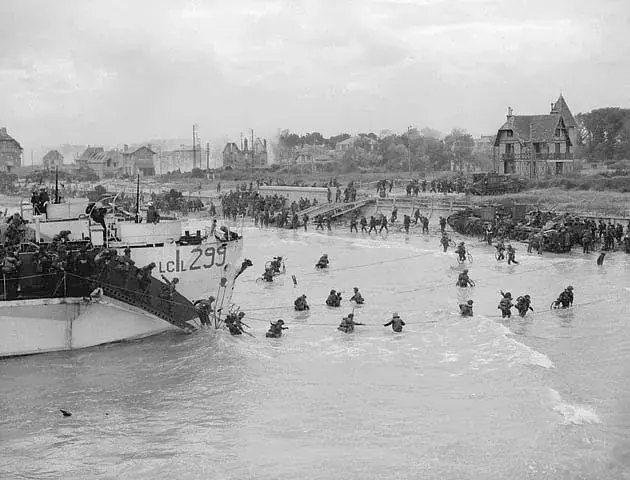
Juno Beach
Juno Beach is one of the most poignant stretches of coastline in Normandy, renowned as the D-Day landing site for Canadian forces during World War II. Spanning from Courseulles-sur-Mer to Saint-Aubin-sur-Mer, this vast expanse of fine golden sand offers a unique blend of profound historical remembrance and classic seaside charm. The beach is dominated by the tides of the English Channel, revealing incredibly wide shores at low tide, perfect for long walks, beachcombing, and flying kites. Visitors are struck by the contrast between the peaceful holiday atmosphere of today and the solemn history represented by the remnants of bunkers and the excellent Juno Beach Centre.
Beyond its historical weight, the coast is a beautiful natural environment, characterized by gentle dunes, coastal grasses, and a refreshing maritime breeze. The towns along the beach feature charming promenades, traditional Norman architecture, and bustling marinas. The water, while crisp, is inviting on warm summer days. The sheer scale of the beach means it rarely feels overcrowded, offering plenty of space for everyone.
Visiting Juno Beach is an emotionally resonant experience that seamlessly transitions into a relaxing coastal getaway. Families can learn about the sacrifices of the past in the morning, and spend the afternoon building sandcastles, exploring tidal pools, or enjoying fresh local seafood by the bustling harbor.
Practical info
Family-friendly & For kids
Highly family-friendly with its safe promenades, massive sandy areas, and educational museums that cater to all generations.
Kids love the vast space for building sandcastles, exploring tidal pools full of crabs at low tide, and running safely on the soft sand.
Food & drink
- Coquilles Saint-Jacques — Fresh local scallops, especially at restaurants around the Courseulles-sur-Mer harbor.
- Norman Crêpes and Galettes — Savoury buckwheat galettes and sweet crêpes served in traditional crêperies along the seafront.
- Oysters (Huîtres) — Fresh oysters sold directly at the local fish markets or served in nearby seafood bistros.
Facilities
- Restrooms
- Showers
- Lifeguard (summer)
- Restaurants nearby
- Juno Beach Centre
- Sailing school
Events nearby
- D-Day Canadian Commemorative Ceremony at the Juno Beach Centre annually on 6 June; 2026 ceremony on 6 June at 09:30 on the Garth Webb Esplanade · annual
Annual ceremony at the Juno Beach Centre on Juno Beach honouring D-Day and the Battle of Normandy, with Canadian official attendance. Part of the wider 6 June commemorations on the Normandy landing beaches. Source - Fete de la Mer (Sea Festival) of Courseulles-sur-Mer annually in August at the port and seafront; in recent years a memorial ceremony around 10 August plus a festive weekend in late August (23-24 Aug in 2025) · annual
Maritime festival celebrating Courseulles' fishing-port heritage, combining a solemn ceremony honouring sailors lost at sea with a festive weekend of concerts, stands and seafaring traditions at the marina and beach. Source - Festival La Semaine Acadienne (Acadian Week) annually in August across the Coeur de Nacre towns; 2026 edition (21st) from 7 to 15 August, including events at the Juno Beach Centre · annual
Cultural festival paying tribute to Acadian soldiers who landed in Normandy in 1944 and celebrating living Acadian culture, with concerts and events across Saint-Aubin-sur-Mer, Courseulles-sur-Mer and neighbouring towns. Source - Acadian Soldiers Tribute Ceremony at the Juno Beach Centre annually during Acadian Week in August; 2026 ceremony on 10 August at 09:30 · annual
Ceremony at the Juno Beach Centre honouring the Acadian soldiers who took part in the D-Day landings, held as part of the annual Semaine Acadienne festival. Source - Janvier Musiq'Halle annually in January in Courseulles-sur-Mer; 2026 edition runs 10-31 January · annual
Winter music festival in Courseulles-sur-Mer showcasing local artists with concerts and live performances. Source
Tips
- Always check the tide schedules before setting out for a long walk on the beach.
- Dress in layers, as the weather in Normandy can change quickly and the breeze can be cool.
- Allocate at least half a day to fully experience the excellent Juno Beach Centre.
FAQ
Is the Juno Beach Centre located directly on the beach?
Can you swim at Juno Beach?
Are dogs allowed on the beach?
Is it safe to walk far out during low tide?
Places nearby
- Douvres-la-Délivrande 5 km
- Ouistreham 13 km
- Blainville-sur-Orne 14 km
- Arromanches 15 km
- Thue et Mue 16 km
- Bretteville-l'Orgueilleuse 16 km
- Hérouville-Saint-Clair 16 km
- Colombelles 17 km
- Caen 17 km
- Caen-Centre 18 km
Beaches nearby
- Sword Beach 8 km
- Gold Beach 11 km
- Omaha Beach 33 km
- Utah Beach 56 km
- Plage de la Vieille église 97 km