Plizio Visual Lab
Nesactium
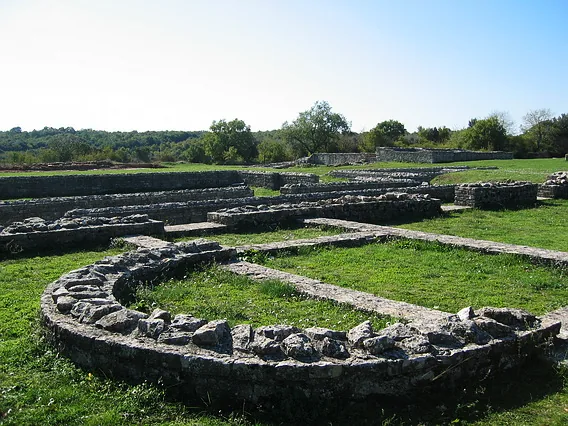
Nesactium, located near the village of Valtura in Istria, was the primary political and religious capital of the Histri tribe, an ancient Illyrian people. Situated on a high plateau, this fortified hillfort controlled the surrounding territory and maritime access to the southern tip of the peninsula. In 177 BC, the city became the site of a final, dramatic stand against the Roman legions led by consuls Claudius Pulcher and Sempronius Gracchus. According to historical accounts, the Histrian king Epulon and his warriors chose death over Roman enslavement as the city fell. Following the Roman victory, the site was transformed into a classical urban center featuring a forum, thermal baths, and temples, whose foundations are still visible today. Notable pre-Roman stone sculptures discovered here represent some of the most important Iron Age art in the Eastern Adriatic. The archaeological park also contains remains of 5th-century early Christian basilicas, showcasing the site's importance through late antiquity. Nesactium remains a crucial archaeological landmark, offering deep insights into the transition from indigenous tribal life to Roman provincial administration.
- Location: Croatia
- Top sights: Basilika Christiana · Zisterna · Nesactium
- Nearby: Marčana (4 km)
Best time to visit & climate
The most pleasant time to visit is Jun, Jul, Sep.
| Jan | Feb | Mar | Apr | May | Jun | Jul | Aug | Sep | Oct | Nov | Dec | |
|---|---|---|---|---|---|---|---|---|---|---|---|---|
| Avg °C | 6 | 6 | 9 | 13 | 17 | 22 | 24 | 24 | 20 | 16 | 11 | 7 |
| Rain mm | 78 | 95 | 74 | 67 | 84 | 64 | 49 | 71 | 113 | 101 | 133 | 102 |
📋 Practical info
Geography
Facts
- Nesactium served as the capital of the ancient Histri tribe
- The Roman conquest of the city occurred in 177 BC
- King Epulon is said to have committed suicide during the final siege
- The site features foundations of three separate Roman temples
- Important Iron Age stone statues were found during excavations
- Ruins of two early Christian basilicas from the 5th century are present
Explore nearby
Notable places around
Route planner — Car & Motorhome
Where do you start? We build the route here, with stops and country notes along the way.
© OpenStreetMap contributors · OpenRouteService
Sights in the town Nesactium (4)
Tabernae
Tabernae are ruins of shops or workshops from the Roman period in Nesactium.
Sights nearby
Frequently asked questions
What was Nesactium?
When did Nesactium's independence end?
Where are the ruins located today?
What can be visited on-site?
Is there an entrance fee?
Nesactium: where is it located?
Nesactium: what is there to see?
Nesactium: when is the best time to visit?
Nesactium: why is it worth visiting?

Nearby cities