Plizio Visual Lab
Växjö Cathedral
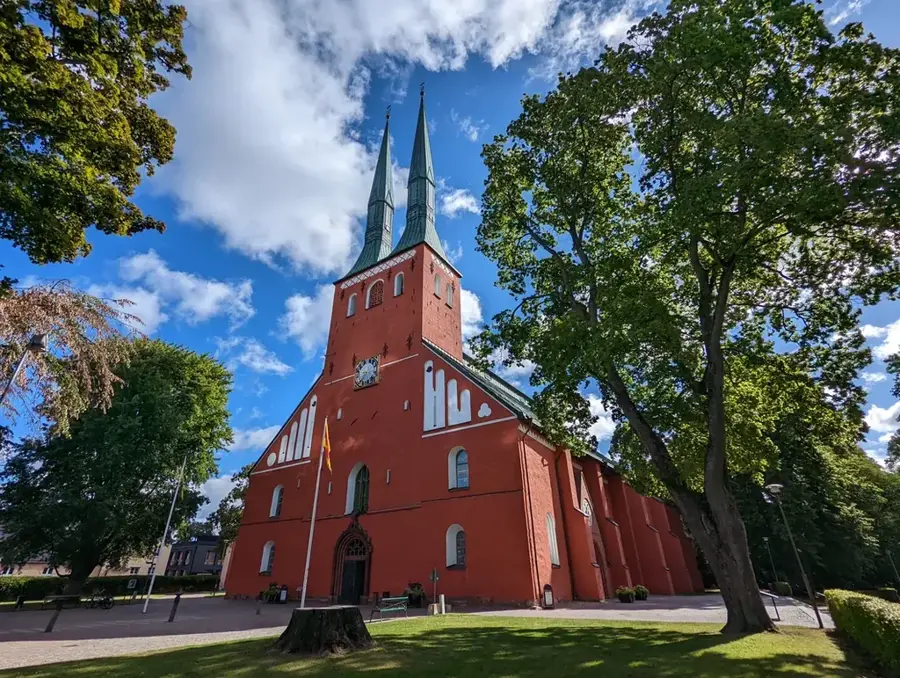
Växjö Cathedral, with its distinctive twin spires, is a landmark of Småland with nearly a thousand years of history. The church's origins date back to the 11th century and are closely tied to Saint Sigfrid, the patron saint of Småland, whose relics were once housed here. Throughout the centuries, the cathedral was destroyed multiple times by devastating fires, most recently in 1843, leading to extensive rebuilds and changes in architectural style. The current appearance blends medieval structures with 19th-century restorations and 20th-century modern glass art. Its interior is particularly striking, reflecting Växjö's reputation as the 'Kingdom of Crystal'; many altar pieces, sculptures, and windows were crafted by renowned glass artists from nearby glassworks like Orrefors and Kosta Boda. The bright, expansive vaults and the artistic marriage of stone and glass create a unique atmosphere within the sacred space. The cathedral serves as the seat of the Diocese of Växjö and is a vital cultural hub for concerts and art exhibitions.
- Location: Sweden
- Top sights: Museum of Småland · Emigrant Institute · Växjö Teater
- Nearby: Ljungby (53 km)
Best time to visit & climate
The most pleasant time to visit is Jun–Aug.
| Jan | Feb | Mar | Apr | May | Jun | Jul | Aug | Sep | Oct | Nov | Dec | |
|---|---|---|---|---|---|---|---|---|---|---|---|---|
| Avg °C | -3 | -2 | 0 | 6 | 11 | 14 | 17 | 16 | 12 | 7 | 3 | -1 |
| Rain mm | 60 | 50 | 46 | 41 | 65 | 85 | 108 | 91 | 65 | 80 | 74 | 67 |
📋 Practical info
Geography
Facts
- The original church was likely founded around the year 1050.
- The cathedral has been damaged by fire at least five times in its history.
- The distinctive twin spires gained their current form after the 1843 fire.
- Inside, there is a prominent glass altarpiece created by Bertil Vallien.
- The cathedral is the burial place of Saint Sigfrid, the missionary of Småland.
- Most of the modern glass decorations were added during the 1990s.
Explore nearby
Notable places around
Route planner — Car & Motorhome
Where do you start? We build the route here, with stops and country notes along the way.
© OpenStreetMap contributors · OpenRouteService
Sights in the town Växjö Cathedral (9)
Växjö Konserthus
Concert hall in Växjö with musical events.
Kampa pelare
Monument in Växjö.
Skogslyckans kyrka
Church building in Växjö Municipality, Sweden.
Västrabokyrkan
Church building in Växjö Municipality, Sweden.
Bokhultets naturreservat
Nature reserve in Kronoberg, Sweden.
Sights nearby
Frequently asked questions
What is the trademark of Växjö Cathedral?
When was the cathedral built?
Is there glass art in the cathedral?
Is entry free?
Who is the patron saint?
Växjö Cathedral: where is it located?
Växjö Cathedral: what is there to see?
Växjö Cathedral: when is the best time to visit?
Växjö Cathedral: why is it worth visiting?

Nearby cities