Plizio Visual Lab

Penyagolosa
Plizio editorial teamData Sources
Mountain
—°7
Penyagolosa (Spain)

Weather…

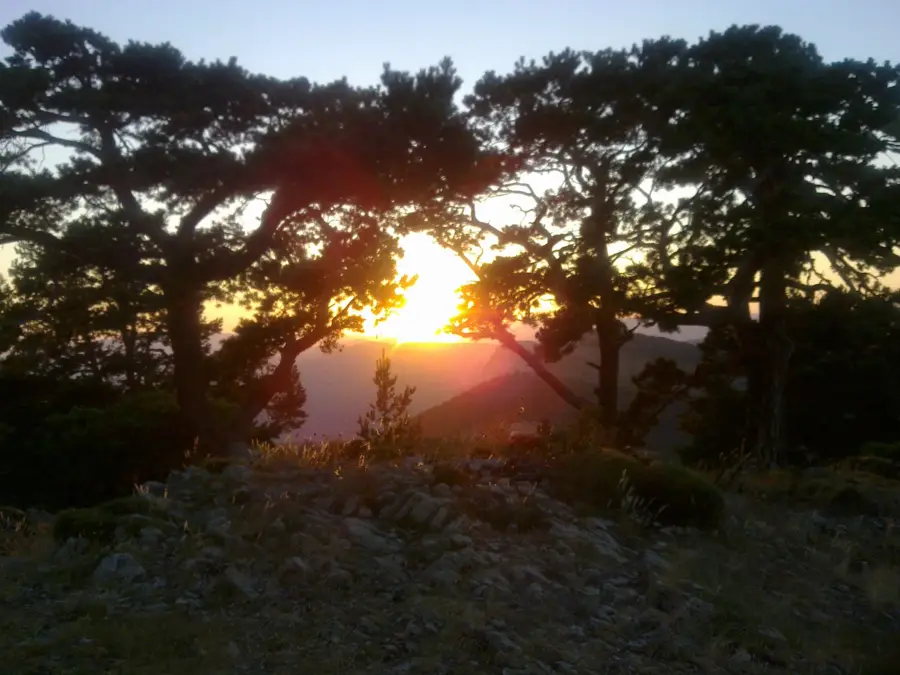
The Penyagolosa massif is the most iconic peak in the province of Castellón, often called the 'Stone Giant' of the Valencian Community. With its distinctive asymmetrical profile featuring a steep southern face and a gentler northern slope, the summit reaches an altitude of 1,813 meters. Geologically, the massif consists primarily of Cretaceous limestone, resulting in a rugged and craggy landscape. Protected as a natural park since 2006, the area is home to rich biodiversity, including forests of black pine and juniper. Culturally, Penyagolosa is considered a sacred mountain, serving as the destination for the medieval pilgrimage 'Els Pelegrins de les Useres,' a tradition that remains active today. The climate is significantly harsher than the nearby coast, with frequent snowfall during the winter months. From the summit, the panoramic view extends from the Ebro Delta to the Balearic Islands on clear days.

Best time to visit & climate

The most pleasant time to visit is Jun–Aug.

JanFebMarAprMayJunJulAugSepOctNovDec
Avg °C6691216212423191596
Rain mm272440444326132349444828

📋 Practical info

🧭
Getting there
The remote mountain is usually accessed by cautiously driving along winding roads from Castellón towards the base sanctuary. Public transport is practically absent, making a reliable private car utterly essential.
📅
Best season
Spring and exceptionally clear autumn days are strictly considered optimal for the ascent, offering comfortably mild temperatures. Peak summer hikes must rigorously commence at dawn to proactively avoid extreme heat.
⛰️
Terrain & paths
The straightforward approach trails quickly begin as wide forested tracks and transition aggressively into steep rocky paths. The final summit push absolutely requires successfully navigating severely jagged limestone terrain.
🎒
What to bring
Exceptionally sturdy mountain hiking boots are absolutely critical for navigating the loose and treacherous limestone safely. Hikers must purposefully carry a completely packed backpack with windproof layers and water.
🅿️
Parking
A defined main parking area is available entirely near the Ermita de Sant Joan, the historic starting point of the climb. It is definitively free but decidedly small, requiring exceptionally early weekend arrival.
⚠️
Safety
Summit weather can be surprisingly windy and drastically colder than base levels, obligating comprehensive protective preparation. Stick rigorously to authorized trails to heavily strictly minimize all cascading rockfall risks.
⏱️
Time needed
The intensely classic hike actively traversing from the sanctuary to the summit naturally takes exactly four to six hours directly. Visitors should realistically plan for a completely full day outing, carefully including all demanding travel.

Geography

Coordinates
40.23000, -0.35000

Facts

  • Penyagolosa is the second-highest peak in the Valencian Community.
  • The natural park covers an area of approximately 1,094 hectares.
  • The southern face features a vertical drop of nearly 300 meters.
  • The Sanctuary of Sant Joan de Penyagolosa is located at the mountain's base.
  • Peregrine falcons and golden eagles nest in the mountain's cliffs.
  • The local pilgrimage takes place annually on the last Friday of April.

Explore nearby

Notable places around
Route planner — Car & Motorhome

Where do you start? We build the route here, with stops and country notes along the way.

Vehicle
Only stops with (optional):

© OpenStreetMap contributors · OpenRouteService

Sights in the town Penyagolosa (7)

Parc Natural de Penyagolosa🌿 nature

A nature park in the province of Castellón encompassing the sacred Penyagolosa mountain.

Petroglifs de la Cambreta🏺 historical

Prehistoric rock carvings located near the Penyagolosa massif.

Poblat Àrab del Marinet🏺 historical

The remains of a medieval Arab settlement near Penyagolosa.

Penyagolosa📍 landmark

The highest peak in the province of Castellón and a symbolic mountain for the Valencian Community.

La Golosilla📍 landmark

A mountain peak located near the Penyagolosa massif in Spain.

Observatori Astronòmic Astropunt de Vistabella🌿 nature

An astronomical observatory and viewpoint in Vistabella del Maestrat.

la Palmerina🏺 historical

Historic ruins in the rural area of the Penyagolosa nature park.

Sights nearby

Frequently asked questions

Why is Penyagolosa called the 'Stone Giant'?
Because of its massive appearance and being the highest peak in the Castellón region at 1813m.
Is there a monastery at the foot of the mountain?
Yes, the Sanctuary of Sant Joan de Penyagolosa is an important pilgrimage site and starting point for hikes.
Can you see the sea from the summit?
On clear days, the summit gives a panoramic view to the Mediterranean and even the Columbretes Islands.
Are there drinking water sources on the way?
There are springs near Sant Joan monastery, but you should carry your own water for the summit climb.
Is the climb dangerous in winter?
In snow and ice, the rocky path can be very slippery. Alpine equipment is then often necessary.
Penyagolosa: where is it located?
Penyagolosa is located in Galicia, Spain.
Penyagolosa: what is there to see?
Highlights include Parc Natural de Penyagolosa, Petroglifs de la Cambreta, Poblat Àrab del Marinet.
Penyagolosa: when is the best time to visit?
The most pleasant time to visit is Jun, Aug.
Penyagolosa: why is it worth visiting?

The Penyagolosa massif is the most iconic peak in the province of Castellón, often called the 'Stone Giant' of the Valencian Community.
View on map → The Top 50 Attractions → Most beautiful beaches → OpenStreetMap →
Europe
Explore with Plizio Discover more places in Europe
More places in Spain →

Nearby cities

History & landmarks