Plizio Visual Lab

Paektu Mountain
Plizio editorial teamData Sources
Mountain
—°1
Paektu Mountain (North Korea)

Weather…

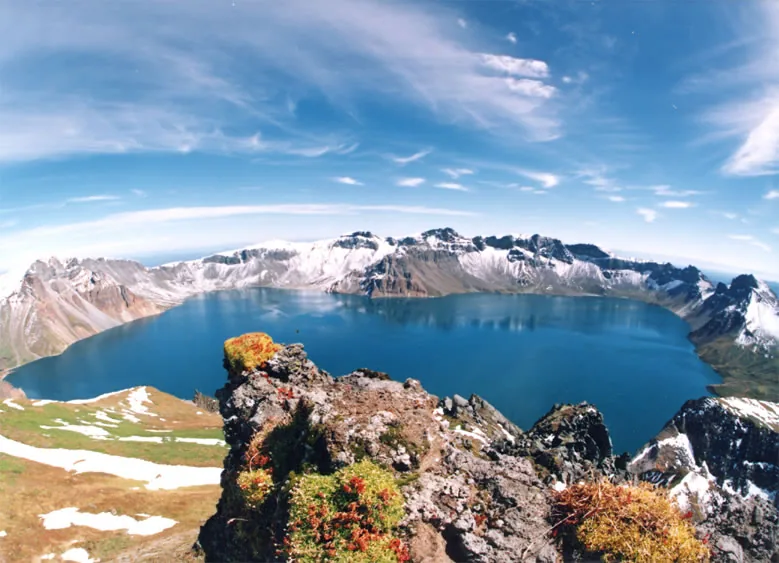
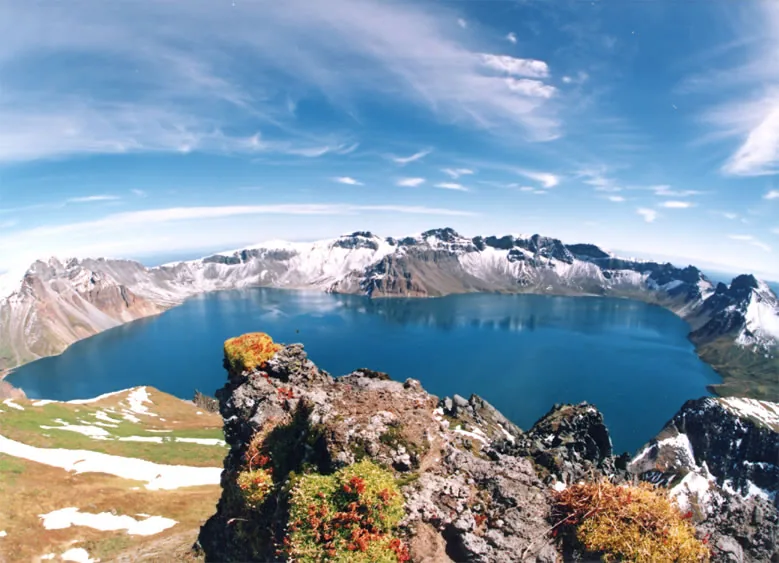
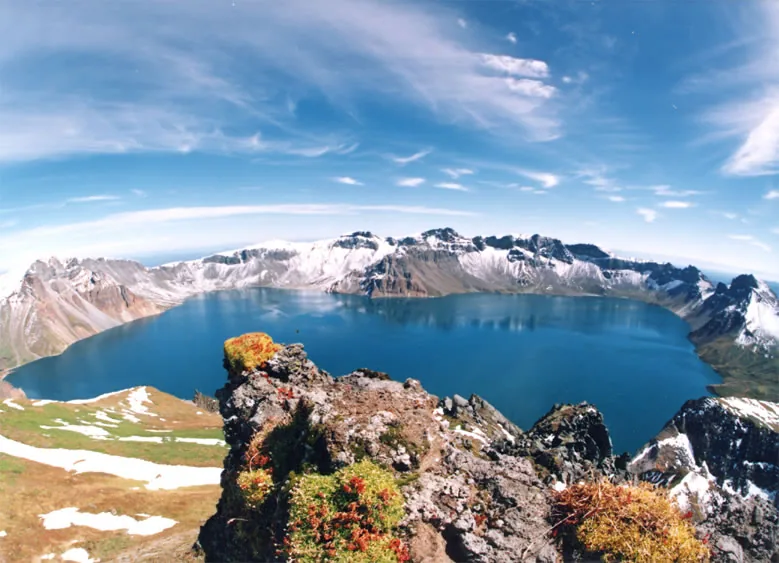
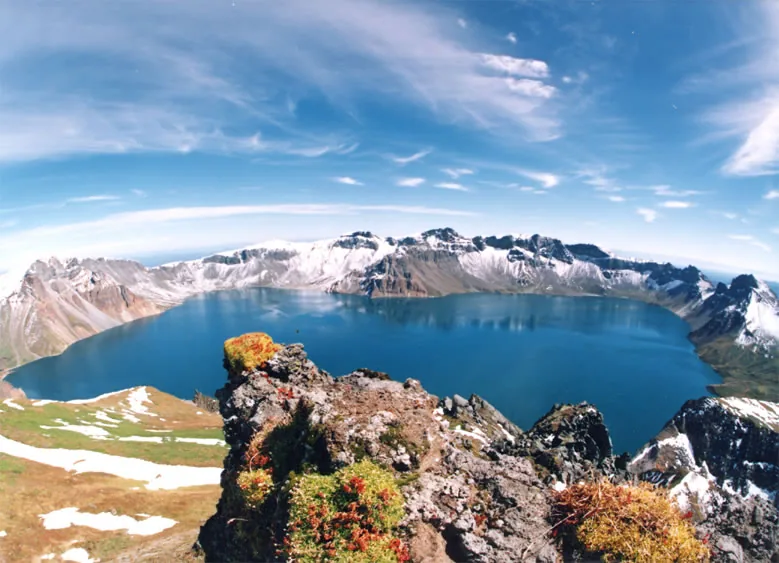
Mount Paektu, also known as Changbaishan on the Chinese side, is the highest peak on the Korean Peninsula at 2,744 meters. Located on the border between North Korea and China, it is revered as a sacred site by all Koreans, regarded as the ancestral origin of the Korean people. The mountain is a dormant stratovolcano whose massive caldera holds Heaven Lake (Chonji), one of the highest crater lakes in the world. The surrounding landscape is characterized by dense forests, hot springs, and spectacular waterfalls. In North Korean historiography, Paektu plays a central role as the base for the anti-Japanese guerrilla struggle and the official birthplace of Kim Jong-il. Each year, numerous pilgrims and tourists visit the region to witness the wide-open scenery and visit historical secret camps. The area is recognized as a biosphere reserve and provides habitat for rare species such as the Siberian tiger and the black bear. Climatic conditions at the summit are extreme, featuring fierce winds and snow cover that often lasts into early summer.

Best time to visit & climate

The most pleasant time to visit is Jun–Aug.

JanFebMarAprMayJunJulAugSepOctNovDec
Avg °C-19-16-918131716102-8-17
Rain mm81623428210617416670393314

📋 Practical info

🧭
Getting there
International access is exceptionally heavily regulated, highly restricted, and can exclusively be properly organized via strictly mandatory official state-sanctioned, heavily guided tours that typically depart either from major interior cities or systematically across the tightly monitored Chinese border crossing.
📅
Best season
The remarkably brief summer months spanning tightly from late June precisely to August reliably offer the single only genuinely safe, predictably clear climatic window available to successfully view the iconic crater lake without enduring severe, completely life-threatening alpine winter blizzards and extreme ice storms.
⛰️
Terrain & paths
The physically demanding final ascent explicitly involves navigating profoundly rugged, severely steep, and barren volcanic rocky scree slopes directly leading up to an immensely dramatic, spectacularly massive caldera rim that securely cradles a strikingly deep, stunningly sapphire-blue, highly revered alpine lake ecosystem.
🎒
What to bring
Highly specialized extreme cold weather mountaineering gear, dependably sturdy, well-insulated, rigidly supported hiking boots, completely windproof thermal outer shell layers, and high-altitude, intense ultraviolet sun protection are deemed absolutely completely mandatory for basic survival and baseline comfort here.
🅿️
Parking
Autonomous, independent private vehicle driving is fundamentally not a legally viable option under any circumstances; all critical transportation logistics and necessary vehicle staging protocols are rigidly, exclusively completely handled entirely by the explicitly assigned, formal state official tour operators themselves.
⚠️
Safety
The volatile, highly unpredictable localized microclimate weather directly at the very summit changes horrifyingly rapidly without meaningful warning; foreign tourists must submissively obey their designated official state guides without fail at all times and simply must never blindly wander away from the closely monitored main group.
⏱️
Time needed
Permitted visits reliably and systematically involve a rigidly structured, intensely paced single-day trip itinerary completely hyper-focused entirely on successfully reaching the lofty summit and efficiently viewing the highly revered, sacred crater lake securely before strictly descending back to absolute lower baseline elevations.

Geography

Coordinates
41.99300, 128.05500

Facts

  • Standing at 2,744 meters, Paektu is the highest peak of the Changbai range.
  • Heaven Lake in the caldera reaches a maximum depth of approximately 384 meters.
  • The volcano's last catastrophic eruption occurred around the year 946 AD.
  • The mountain plateau consists largely of volcanic pumice stone.
  • Mount Paektu is the source of the Amnok (Yalu) and Tuman rivers.
  • The average annual temperature at the summit is a mere -8.3 °C.

Explore nearby

Notable places around
Route planner — Car & Motorhome

Where do you start? We build the route here, with stops and country notes along the way.

Vehicle
Only stops with (optional):

© OpenStreetMap contributors · OpenRouteService

Sights in the town Paektu Mountain (1)

Changbai Mountain West Slope🌿 nature

A viewpoint on the western slope of the Changbai Mountains, overlooking the volcanic peak and the surrounding taiga.

Sights nearby

Frequently asked questions

How do you get to Mount Paektu?
Tourists usually fly from Pyongyang to Samjiyon and then take buses to the summit.
When is the best time to visit Mount Paektu?
Only from June to September is the mountain clear enough of snow for a safe visit.
Is the climb difficult?
There is a funicular and roads almost to the summit, so heavy hiking is not required.
Why is the mountain considered sacred?
It is considered the birthplace of the Korean nation and plays a central role in history.
Are there accommodations nearby?
Visitors usually stay in hotels in Samjiyon, such as the Pegaebong Hotel.
Paektu Mountain: where is it located?
Paektu Mountain is located in North Korea.
Paektu Mountain: when is the best time to visit?
The most pleasant time to visit is Jun, Aug.
Paektu Mountain: why is it worth visiting?

Mount Paektu, also known as Changbaishan on the Chinese side, is the highest peak on the Korean Peninsula at 2,744 meters.
View on map → The Top 50 Attractions → OpenStreetMap →
Asia
Explore with Plizio Discover more places in Asia
More places in North Korea →

Nearby cities

Nature

More places