Plizio Visual Lab

High Westerwald
Plizio editorial teamData Sources
Mountain
—°8
High Westerwald (Germany)

Weather…

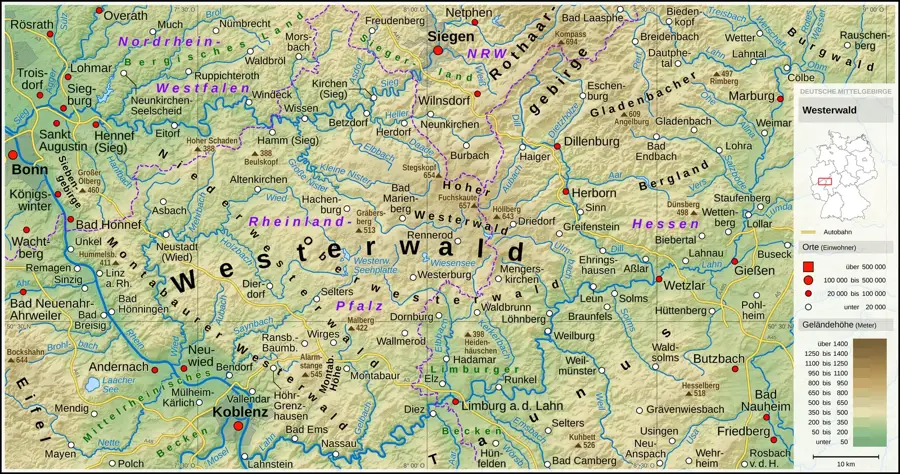
The High Westerwald represents the highest elevated part of the Westerwald mountain range, spanning the German states of Rhineland-Palatinate, Hesse, and North Rhine-Westphalia. Geologically, the region was formed by volcanic activity during the Tertiary period, resulting in extensive basalt deposits that define its rugged topography. The highest peak is the Fuchskaute, reaching an elevation of 657 meters above sea level, situated near the boundary of the three federal states. Historically, the harsh climate and rocky soil made traditional farming difficult, leading the local population to rely on basalt quarrying, clay mining, and forestry. The plateau serves as a significant watershed between the Rhine and Lahn river systems, hosting the headwaters of several regional streams. Today, much of the area is integrated into the Westerwald-Sieg Nature Park, focusing on the preservation of its diverse ecosystems, including ancient beech forests and highland moors. The region is also noted for its scattered settlements and cultural heritage deeply rooted in the exploitation of its natural mineral resources.

Best time to visit & climate

The most pleasant time to visit is Jun–Aug.

JanFebMarAprMayJunJulAugSepOctNovDec
Avg °C01491316191814941
Rain mm715756477468767357606877

📋 Practical info

🧭
Getting there
The high plateaus are generally reached via scenic regional roads crossing the borders of Hesse and Rhineland-Palatinate, with various rural access points leading directly to the main paths.
📅
Best season
Late spring to autumn is widely considered the best time to visit, offering lush green landscapes and mild temperatures excellent for long-distance hiking across the elevated plateau terrain.
⛰️
Terrain & paths
Characterized by expansive high plateaus and dense, shaded woodlands, the pathways are mostly wide and well-trodden, offering relatively flat sections mixed with gentle, sustained climbs.
🎒
What to bring
Pack reliable walking shoes suitable for extended distances, a lightweight waterproof jacket to handle sudden showers, and sufficient snacks and hydration for traversing the long plateau routes.
🅿️
Parking
Travelers can generally find convenient parking spaces in the small towns and dedicated hiking lots scattered across the region, providing immediate access to the extensive trail system.
⚠️
Safety
The area is very safe for general recreation, but visitors should be prepared for noticeable temperature drops on the exposed plateaus and always carry a charged phone for rural navigation.
⏱️
Time needed
The extensive network of trails makes this area convenient for full-day excursions or even multi-day trekking adventures, though shorter, focused loops of a few hours are also easily possible.

Geography

Coordinates
50.60000, 8.08300

Facts

  • The Fuchskaute peak stands at 657 meters, making it the highest point of the range.
  • The basalt plateau was created by volcanic eruptions approximately 25 million years ago.
  • The Nister river, a major tributary of the Sieg, has its source in this highland region.
  • The High Westerwald receives high annual precipitation, often exceeding 1000 mm.
  • Basalt quarrying was historically the most significant industrial activity in the area.
  • Bad Marienberg is the primary center for health resorts and alpine tourism in the region.

Explore nearby

Notable places around

Route planner — Car & Motorhome

Where do you start? We build the route here, with stops and country notes along the way.

Vehicle
Only stops with (optional):

© OpenStreetMap contributors · OpenRouteService

Sights in the town High Westerwald (8)

Liegewiese Secker Weiher🎡 recreation

A sunbathing lawn at the Secker Weiher pond, popular for summer relaxation.

🕒 Mo-Su 00:00-19:00💶

Badestrand🎡 recreation

A bathing beach in the High Westerwald for summer leisure activities.

Theater🎭 culture

A local cultural venue for theatrical performances in the High Westerwald.

Seitenstein📍 landmark

A distinctive basalt rock formation and viewpoint in the High Westerwald.

Kirnberg📍 landmark

A hill in the High Westerwald, typical of the local low mountain landscape.

Böhlen📍 landmark

An elevation in the High Westerwald, appealing to hikers through its nature.

Klosterruine Selingenstatt🏺 historical

The ruins of a former monastery, which now serve as a historical monument.

Sights nearby

Frequently asked questions

Where is the highest point in the Westerwald?
The Fuchskaute is the highest mountain in the range at 657 m above sea level.
What is the Westerwald-Steig?
A 235 km long certified hiking trail that runs across the region.
Are there attractions for families?
The Bad Marienberg Wildlife Park is a popular destination with native animal species.
What is the climate like in the High Westerwald?
It is often windy and cooler than in the Rhine Valley; weather-resistant clothing is advised.
Can you go skiing in the Westerwald in winter?
Yes, there are small lifts and trails, e.g., near Bad Marienberg or the Fuchskaute.
High Westerwald: where is it located?
High Westerwald is located in Hesse, Germany.
High Westerwald: what is there to see?
Highlights include Wacholderheide Westernohe, Liegewiese Secker Weiher, Badestrand.
High Westerwald: when is the best time to visit?
The most pleasant time to visit is Jun, Aug.
High Westerwald: why is it worth visiting?

The High Westerwald represents the highest elevated part of the Westerwald mountain range, spanning the German states of Rhineland-Palatinate, Hesse, and North Rhine-Westphalia.
View on map → The Top 50 Attractions → Most beautiful beaches → OpenStreetMap →
Europe
Explore with Plizio Discover more places in Europe
More places in Germany →

Nearby cities