Plizio Visual Lab
Warsaw Barbican
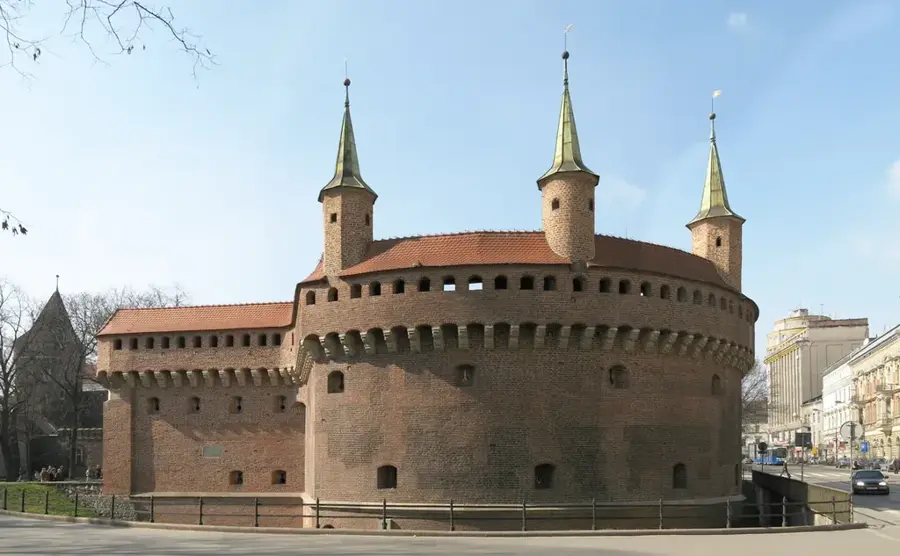
The Warsaw Barbican (Barbakan Warszawski) is one of the most recognizable and imposing historical landmarks in the Polish capital. Functioning as a semicircular, heavily fortified outpost, it serves as the iconic architectural gateway bridging the Old Town and the New Town. It was designed around 1540 by the Italian architect Jan Baptist the Venetian to dramatically reinforce the northern city walls and protect the main access route. Despite its impressive blend of Gothic and Renaissance architecture, the Barbican almost never served its intended military purpose, as rapid advancements in artillery technology rendered such defensive walls largely obsolete shortly after its completion. During the tragic Warsaw Uprising in 1944, the structure was almost completely obliterated. Its painstaking reconstruction in the 1950s, which inventively utilized original Gothic bricks salvaged from ruined historical buildings in Silesian towns, transformed the Barbican into a powerful symbol of Warsaw's indomitable resilience.
- Location: Poland
- Top sights: Warsaw Barbican · Muzeum Cechu Rzemiosł Skórzanych · Scena Letnia w Lapidarium
- Nearby: Ząbki (9 km)
Best time to visit & climate
The most pleasant time to visit is Jun–Aug.
| Jan | Feb | Mar | Apr | May | Jun | Jul | Aug | Sep | Oct | Nov | Dec | |
|---|---|---|---|---|---|---|---|---|---|---|---|---|
| Avg °C | -4 | -2 | 2 | 9 | 14 | 18 | 20 | 20 | 15 | 8 | 3 | -2 |
| Rain mm | 44 | 37 | 37 | 40 | 72 | 67 | 74 | 64 | 51 | 49 | 44 | 45 |
📋 Practical info
Geography
Explore nearby
Notable places around
Route planner — Car & Motorhome
Where do you start? We build the route here, with stops and country notes along the way.
© OpenStreetMap contributors · OpenRouteService
Sights in the town Warsaw Barbican (10)
Pauline Church of the Holy Spirit and Paul The Hermit⛪ church
18th-century Baroque Pauline church in Warsaw's Old Town.
Per Artem Ad Deum
Art gallery with rotating exhibitions of contemporary Polish artists.
Instytut Słowacki
Slovak Cultural Institute offering a library, exhibitions, and events.
Statue of the Little Insurgent
Bronze statue by Jerzy Jarnuszkiewicz of a young insurgent, commemorating the Warsaw Uprising.
Museum of Illusion🏛 museum
Interactive museum with optical illusions and illusion rooms.
Saint Hyacinth's Church⛪ church
17th-century Baroque Dominican church in Warsaw's New Town.
Sights nearby
Frequently asked questions
What is the Warsaw Barbican?
Is the building an original medieval structure?
Can you walk on the Barbican?
Does it cost to visit the Barbican?
When is the Barbican most beautiful?
Warsaw Barbican: where is it located?
Warsaw Barbican: what is there to see?
Warsaw Barbican: when is the best time to visit?
Warsaw Barbican: why is it worth visiting?

Nearby cities