Plizio Visual Lab

Giant Wild Goose Pagoda
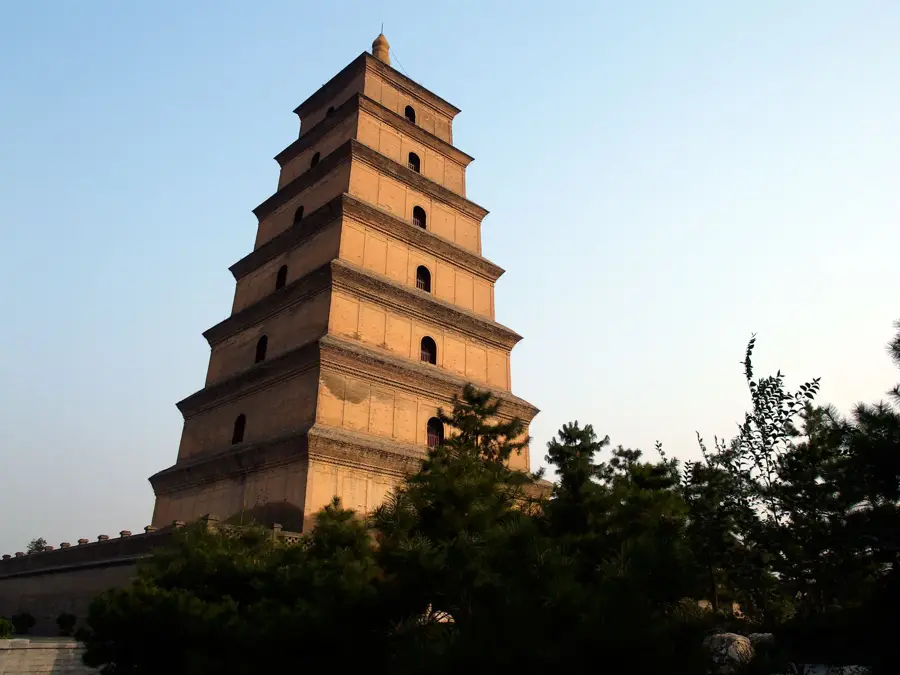
Plizio editorial teamData Sources
monument
—°16
Giant Wild Goose Pagoda (China)

Weather…

The Giant Wild Goose Pagoda in Xi'an is one of the most significant symbols of the Tang Dynasty and a masterpiece of Buddhist architecture in China. It was originally constructed in 652 AD under the reign of Emperor Gaozong to house the sutras and holy relics brought back from India by the famous monk Xuanzang. The pagoda initially stood five stories tall, but it was rebuilt in 704 AD and now reaches a height of 64 meters across seven tiers. The structure is built from solid brick and features a square floor plan typical of the architectural style of that era. Over the centuries, the pagoda has developed a slight lean due to soil movement, though its structural integrity remains sound. Located within the Da Ci'en Temple complex, it is now a protected UNESCO World Heritage site along the Silk Road. The pagoda remains a vivid testament to the cultural and spiritual exchange between China and India during the Middle Ages.

Best time to visit & climate

The most pleasant time to visit is May, Jun, Aug.

JanFebMarAprMayJunJulAugSepOctNovDec
Avg °C-227131822242318125-1
Rain mm9142646849614512514169306

📋 Practical info

🚪
Visiting
The Giant Wild Goose Pagoda is a Buddhist structure in Xi'an that can be visited both outside and inside. Inside you'll find religious relics and an observation deck. Entry is ticketed; tickets are available on site.
🕒
Typical hours
The pagoda typically opens from 8:00 to 17:30, with last entry about 30 minutes before closing. Hours may extend during peak season.
📷
Photography
Photography is allowed outdoors, giving great views of the pagoda and the surrounding old town. Flash is usually prohibited inside to protect the relics.
⏱️
Time needed
Allow about 1 to 1.5 hours for the visit, including climbing the pagoda and exploring the adjacent temple grounds. If you want to walk the park and shops, plan for 2 hours.
Combine with
Combine the Giant Wild Goose Pagoda visit with a stroll in the nearby Tang Paradise Park. The Muslim Quarter of Xi'an with its markets is also within walking distance.
🧭
Getting there
The pagoda is located south of Xi'an and easily reached by bus (lines 5, 19, 21) or metro (Line 3, Dayanta station). Taxis are also a convenient option.
💡
Insider tip
Go early in the morning to avoid crowds and photograph the pagoda in the best light. Don't forget comfortable shoes as you'll climb many steps.

Geography

Coordinates
34.21900, 108.95900

Facts

  • The pagoda was originally completed in the year 652 AD.
  • The current structure stands 64 meters tall with seven levels.
  • Monk Xuanzang translated 1,335 volumes of Buddhist scriptures at this site.
  • A massive earthquake in 1556 caused significant damage to the structure.
  • The pagoda currently has a lean of about one meter toward the northwest.
  • It is part of the UNESCO World Heritage Silk Road routes network.

Explore nearby

Notable places around

Route planner — Car & Motorhome

Where do you start? We build the route here, with stops and country notes along the way.

Vehicle
Only stops with (optional):

© OpenStreetMap contributors · OpenRouteService

Sights in the town Giant Wild Goose Pagoda (16)

Xi'an Drum Tower Museum🏛 museum

This museum inside Xi'an's historic Drum Tower houses a collection of ancient ceremonial drums.

Xi'an Stele Forest Museum🏛 museum

The museum displays over 3,000 stone steles and is one of the most important collections of Chinese calligraphy.

🕒 Mo-Su 09:00-17:00💶

Shaanxi History Museum🏛 museum

One of China's largest museums, with architecture echoing the grandeur of the Tang Dynasty.

🕒 Tu-Su 09:00-17:30🆓

Mausoleum Duling🏺 historical

The monumental burial site of Emperor Xuan of the Han Dynasty lies to the south of Xi'an.

Daxingshan Temple⛪ religious

One of the oldest Buddhist temples in the city, known as the birthplace of esoteric Buddhism in China.

Da Ci'en Temple⛪ religious

This historic temple complex houses the famous 7th-century Giant Wild Goose Pagoda.

Duchenghuang Temple of Xi'an⛪ religious

This magnificent City God Temple impresses with its traditional architecture from the Ming and Qing eras.

Site of Huanqiu📍 landmark

A circular altar from the Tang Dynasty where emperors performed sacrifices to heaven.

Small Wild Goose Pagoda📍 landmark

This elegant pagoda was built in the 8th century to preserve Buddhist scriptures brought from India.

🕒 We-Mo 09:00-17:00

Daming Palace National Heritage Park📍 landmark

This national park protects the remains of the once massive imperial palace of the Tang Dynasty.

Xi'an Botanical Garden🌳 park

A sprawling garden showcasing the diverse plant life of Shaanxi province and Northwest China.

Tang Paradise🎡 recreation

This theme park recreates the glory of the Tang Dynasty with magnificent pagodas and nightly water shows.

Revolution Park🌳 park

Created in 1927, this park commemorates the victims of the Siege of Xi'an during the Northern Expedition.

🕒 24/7

Baijuyi's Former Residence🏺 historical

This archaeological site marks the former residence of Bai Juyi, one of the Tang Dynasty's most famous poets.

Heritage Site of sewer of Qujiang Chi🏺 historical

The ruins expose the sophisticated underground drainage system of the ancient Qujiang Chi park.

Shaanxi Grand Theatre🎭 culture

This modern building is a central venue for opera and contemporary theater performances in Xi'an.

Sights nearby

Frequently asked questions

Can you climb the pagoda?
Yes, for an additional fee, you can climb the internal stairs to the top.
What is the musical fountain show?
A huge water show on the North Square, illuminated and set to music in the evenings.
When was it built?
The pagoda was completed in 652 during the Tang Dynasty.
What was its original purpose?
To house Buddhist scriptures brought back from India by the monk Xuanzang.
How do you get there?
Take subway Line 3 or 4 to Dayanta Station.
Giant Wild Goose Pagoda: where is it located?
Giant Wild Goose Pagoda is located in China.
Giant Wild Goose Pagoda: what is there to see?
Highlights include Xi'an Drum Tower Museum, Xi'an Stele Forest Museum, Shaanxi History Museum.
Giant Wild Goose Pagoda: when is the best time to visit?
The most pleasant time to visit is May, Jun, Aug.
Giant Wild Goose Pagoda: why is it worth visiting?

The Giant Wild Goose Pagoda in Xi'an is one of the most significant symbols of the Tang Dynasty and a masterpiece of Buddhist architecture in China.
View on map → The Top 50 Attractions → OpenStreetMap →
Asia
Explore with Plizio Discover more places in Asia
More places in China →

More places