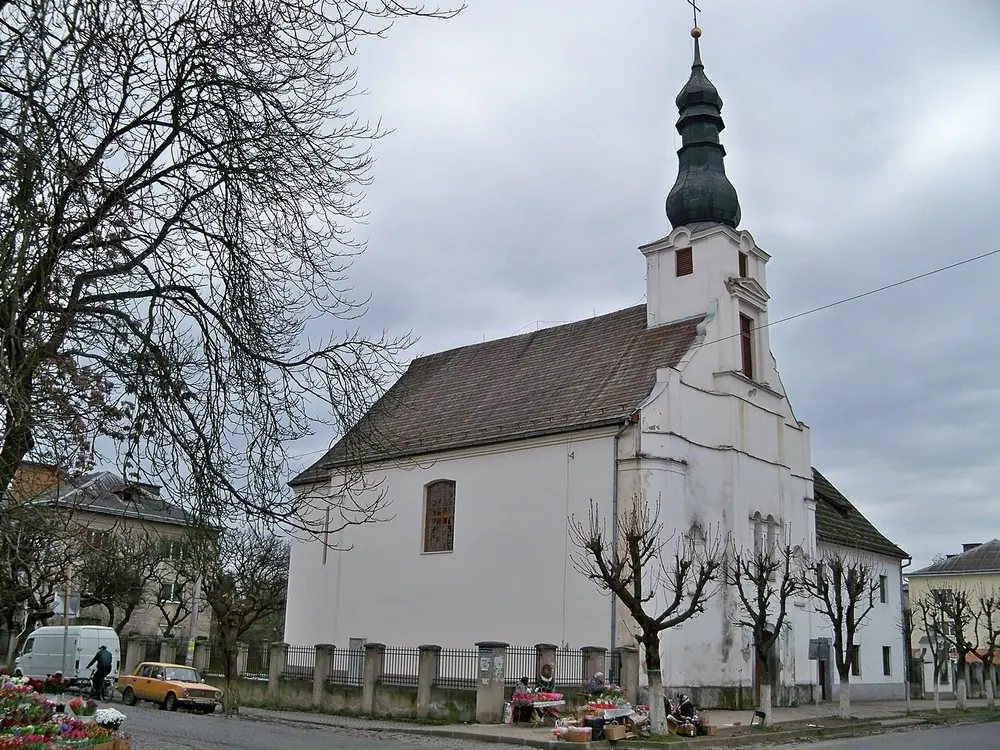
Frantsiskans'kii Monastir
The Franciscan Monastery in Vynohradiv (historically known as Nagyszőlős) stands as one of the most significant architectural and religious monuments in the Zakarpattia region of Ukraine. Dating back to the 15th and 16th centuries, the complex has witnessed a tumultuous history, surviving various conflicts, religious shifts, and political transformations. Originally built in the Gothic style, the structure was later rebuilt with Baroque elements, reflecting the architectural evolution of the region. The monastery complex includes the impressive Catholic church, characterized by its sturdy walls and elegant bell tower, which dominates the local skyline. Inside, visitors can admire the historic atmosphere, classical ecclesiastical art, and the serene ambiance that has served worshippers for hundreds of years. The monastery played a crucial role in the cultural and educational life of the local community, serving as a center of learning. Today, it remains an active place of worship and a testament to the enduring presence of the Franciscan order in Transcarpathia, attracting history enthusiasts and pilgrims alike who wish to explore the rich multicultural heritage of the area.
Weather…
Best time to visit & climate
The most pleasant time to visit is Jun–Aug.
| Jan | Feb | Mar | Apr | May | Jun | Jul | Aug | Sep | Oct | Nov | Dec | |
|---|---|---|---|---|---|---|---|---|---|---|---|---|
| Avg °C | -3 | -1 | 4 | 11 | 16 | 20 | 22 | 22 | 17 | 10 | 5 | -1 |
| Rain mm | 52 | 48 | 54 | 47 | 84 | 87 | 91 | 60 | 62 | 62 | 55 | 56 |
Practical info
Tips
- Be mindful and respectful of any ongoing religious services.
- Take time to explore the town center of Vynohradiv afterwards.
- The elegant bell tower makes for a great photography subject.
FAQ
What is the Franciscan Monastery in Vynohradiv?
How old is the building?
Can tourists visit the interior?
What architectural styles can be seen?
Why is the site historically significant?
Route planner — Car & Motorhome
Where do you start? We build the route here, with stops and country notes along the way.
© OpenStreetMap contributors · OpenRouteService
Attractions nearby
- Vinogradivs'kii zamok 1 km
- Mis'kii skver 41 km
- Uchnivs'kii dendrologichnii park 41 km
- Skver imeni Andriia Kuz'menka 41 km
- Kolochavs'ka vuzkokoliika 59 km
- Solene ozero 64 km