Plizio Visual Lab

Fichtel Mountains
Plizio editorial teamData Sources
Mountain
—°7
Fichtel Mountains (Germany)

Weather…

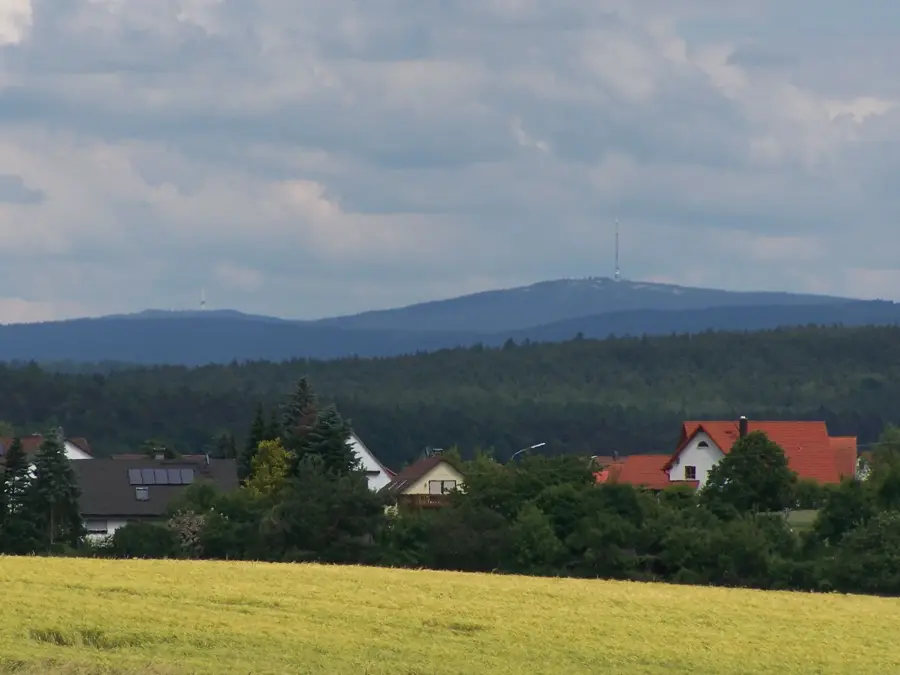
The Fichtel Mountains are a horseshoe-shaped central upland range in northeastern Bavaria, geologically recognized as one of Germany's oldest mountain systems. They consist predominantly of granite formed during the Carboniferous period, roughly 300 million years ago, through deep crustal intrusions later exposed by erosion. The highest peak is the Schneeberg at 1,051 meters, followed by the Ochsenkopf at 1,024 meters. A unique feature of the range is its role as a central European watershed, serving as the source for the Main, Saale, Eger, and Naab rivers, which drain into three different seas. The landscape is characterized by dense spruce forests, high moors, and striking granite blockfields, such as those found in the Luisenburg Rock Labyrinth. Historically, the region held great economic significance due to the mining of tin, iron, and gold, as well as glassmaking and the porcelain industry centered in Selb.

Best time to visit & climate

The most pleasant time to visit is Jun–Aug.

JanFebMarAprMayJunJulAugSepOctNovDec
Avg °C-3-228121618181383-1
Rain mm655053417371817360576268

📋 Practical info

🧭
Getting there
The mountain range is easily approachable via major highways in northeastern Bavaria, with numerous well-signposted regional roads directing visitors to the key natural attractions.
📅
Best season
Summer provides long days for extensive hiking through the mystical rock formations, while winter draws crowds for cross-country skiing and snowy walks in a quiet, frosty environment.
⛰️
Terrain & paths
Expect a heavily forested, horseshoe-shaped range marked by impressive granite boulders, gentle climbs, and an extensive network of generally well-marked and maintained trails.
🎒
What to bring
Dependable hiking footwear is required to safely navigate the rocky sections. Bring layers for changing temperatures, a waterproof jacket, and a map or GPS device for the deep forest.
🅿️
Parking
Most official trailheads, small ski lifts, and popular rock labyrinths feature dedicated parking lots that are generally accessible, though a small daily fee is sometimes required.
⚠️
Safety
The massive granite block fields can become extremely slippery when wet or covered in moss. In winter, ensure your vehicle is properly equipped for snowy and icy road conditions.
⏱️
Time needed
While a hike to one of the main peaks typically takes about a half-day, the abundance of trails makes it easy to stretch your visit into a full weekend of continuous exploration.

Geography

Coordinates
50.05000, 11.83300

Facts

  • Highest point is the Schneeberg at 1,051 meters.
  • Source of four major rivers: Main, Saale, Eger, and Naab.
  • The Luisenburg Labyrinth is Europe's largest granite rock labyrinth.
  • Granite deposits formed approximately 300 million years ago.
  • The center of the German porcelain industry is in Selb.
  • The mountain range covers an area of about 1,000 square kilometers.

Explore nearby

Notable places around
Route planner — Car & Motorhome

Where do you start? We build the route here, with stops and country notes along the way.

Vehicle
Only stops with (optional):

© OpenStreetMap contributors · OpenRouteService

Sights in the town Fichtel Mountains (7)

Burgstall Rudolfstein🏺 historical

The remains of a medieval castle on a rock in the Fichtel Mountains.

Schneeberggipfel🌿 nature

The summit plateau of Schneeberg, the highest mountain in the Fichtel Mountains.

Asenturm🌿 nature

An observation tower on Mount Ochsenkopf, offering extensive views over the region.

Schneeberg📍 landmark

The Schneeberg is the highest peak of the Fichtel Mountains in Bavaria, reaching an elevation of 1,051 meters.

Haberstein📍 landmark

The Haberstein is a prominent granite rock formation located on the slopes of the Schneeberg in the Fichtel Mountains.

Seehügel📍 landmark

The Seehügel is a forested mountain peak located in the Fichtel Mountains of Bavaria.

Naturmoorbad Fleckl🎡 recreation

A natural moor bath and water park located in the Fichtel Mountains.

Sights nearby

Frequently asked questions

What is the highest peak in the Fichtelgebirge?
The Schneeberg is the highest elevation in Franconia at 1051 meters.
Are there winter sports facilities in the Fichtelgebirge?
Yes, especially the Ochsenkopf gives downhill slopes and cross-country trails.
What is the Luisenburg Rock Labyrinth?
It is a massive granite rock sea near Wunsiedel, accessible via marked paths.
Which industry is the Selb region famous for?
Selb is the center of the German porcelain industry with many factory outlets.
When is the best time for hiking in the Fichtelgebirge?
The months from May to October are good for hiking on the Franconian Mountain Trail.
Fichtel Mountains: where is it located?
Fichtel Mountains is located in Thuringia, Germany.
Fichtel Mountains: what is there to see?
Highlights include Burgstall Rudolfstein, Schneeberggipfel, Asenturm.
Fichtel Mountains: when is the best time to visit?
The most pleasant time to visit is Jun, Aug.
Fichtel Mountains: why is it worth visiting?

The Fichtel Mountains are a horseshoe-shaped central upland range in northeastern Bavaria, geologically recognized as one of Germany's oldest mountain systems.
View on map → The Top 50 Attractions → Most beautiful beaches → OpenStreetMap →
Europe
Explore with Plizio Discover more places in Europe
More places in Germany →

Nearby cities