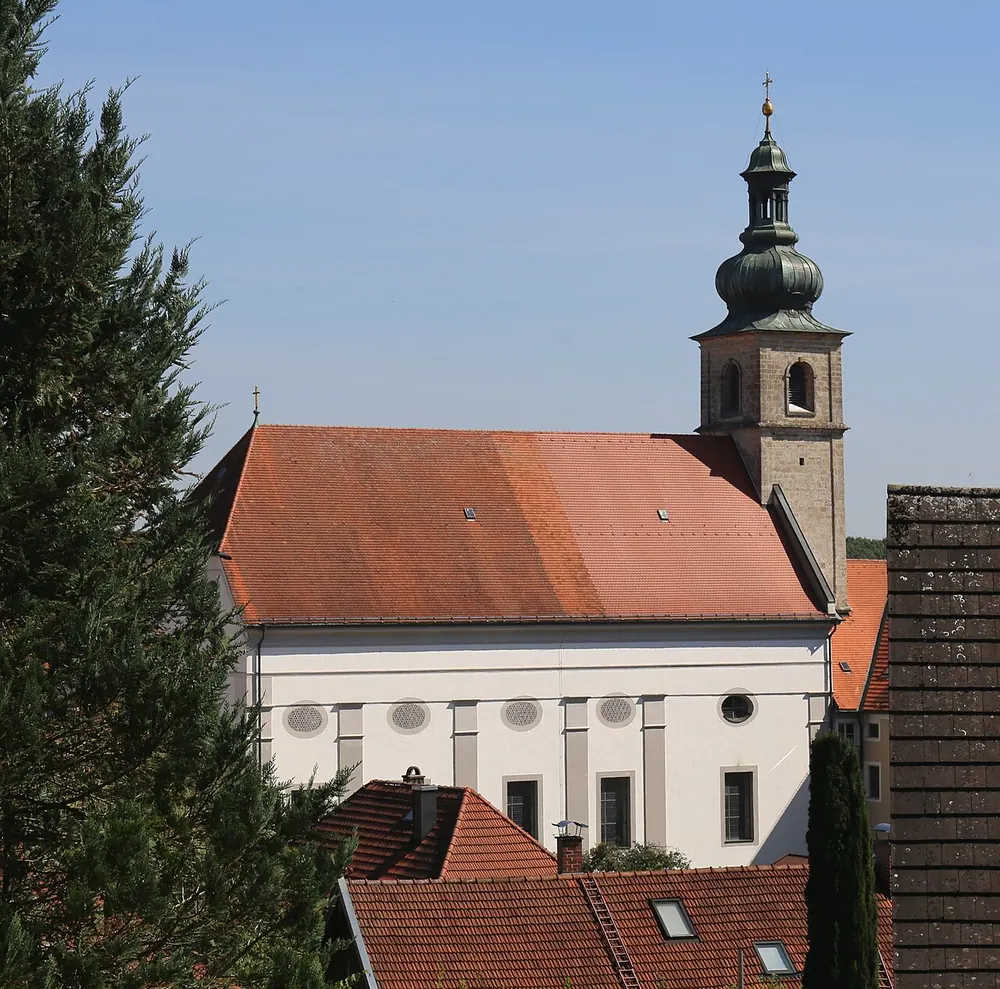
Allerheiligenkirche
The Allerheiligenkirche (All Saints' Church) in Tittmoning, Bavaria, is a significant architectural landmark with a rich history. Originally built as a monastery church for the Augustinian Hermits, the structure has deep roots in the region's spiritual life. The monastery was established in the late 17th century, bringing religious and cultural flourishing to Tittmoning, a town beautifully situated along the Salzach river near the Austrian border.
The church is most celebrated for its magnificent Baroque interior. Visitors entering the Allerheiligenkirche are greeted by elaborate stucco work, ornate altars, and beautiful ceiling frescoes that reflect the artistic tastes of the era. The craftsmanship on display demonstrates the historical importance of the church and the exceptional skill of regional artisans. The harmonious blending of architecture and religious art creates an atmosphere of historical grandeur.
Beyond its architectural beauty, the former monastery church remains a central piece of Tittmoning's historical fabric. Although the monastery was dissolved during the secularization in the early 19th century, the church survived as a testament to the town's monastic past. Exploring it offers a peaceful experience, providing a glimpse into the ecclesiastical heritage of Upper Bavaria.
Weather…
Best time to visit & climate
The most pleasant time to visit is Jun–Aug.
| Jan | Feb | Mar | Apr | May | Jun | Jul | Aug | Sep | Oct | Nov | Dec | |
|---|---|---|---|---|---|---|---|---|---|---|---|---|
| Avg °C | -1 | -1 | 4 | 9 | 13 | 17 | 19 | 18 | 14 | 9 | 4 | 0 |
| Rain mm | 92 | 72 | 84 | 72 | 136 | 158 | 146 | 153 | 113 | 90 | 69 | 79 |
Practical info
Tips
- Take time to explore the historic town square of Tittmoning.
- Walk up to Tittmoning Castle for a great view over the region.
FAQ
What is the Allerheiligenkirche?
When was the church built?
What are the highlights of the interior?
Can the public visit the church?
Route planner — Car & Motorhome
Where do you start? We build the route here, with stops and country notes along the way.
© OpenStreetMap contributors · OpenRouteService
Attractions nearby
- Adelmannschloß 69 km
- Abteikirche Seligenthal 70 km
- Alter Wehrturm 77 km
- Alte Kiesgrube bei Vötting 85 km
- Abschnittsbefestigung Puch 116 km
- Pfeifturm 126 km