Plizio Visual Lab

An Nafud
Plizio editorial teamData Sources
desert
—°1
An Nafud (Saudi Arabia)

Weather…

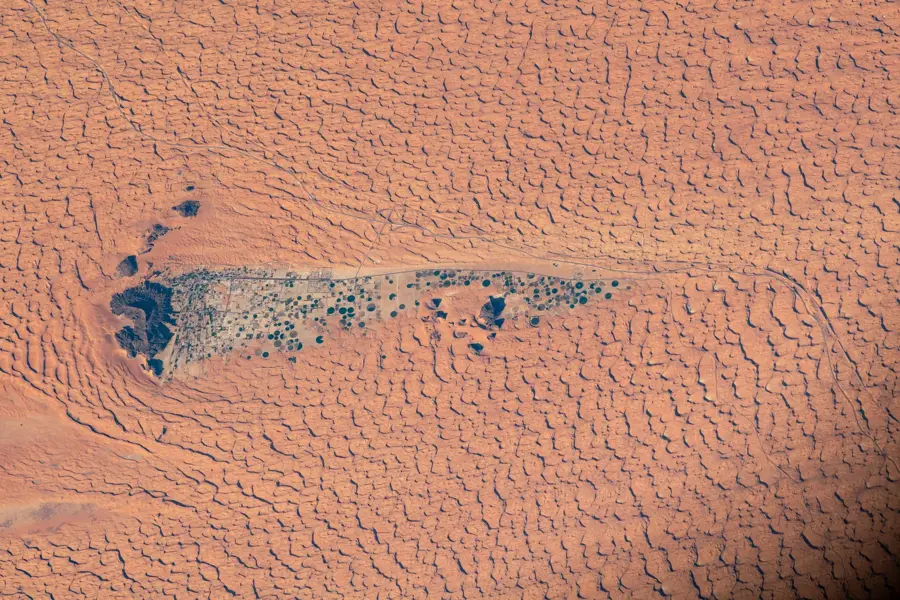
The An Nafud desert, located in the northern part of the Arabian Peninsula, is a vast sand sea covering an area of approximately 65,000 square kilometers. It is renowned for its fine, reddish-colored sand, a hue derived from iron oxide minerals, and its massive crescent-shaped dunes. Geologically, the desert is an erg that is constantly reshaped by powerful winds, connecting to the Rub' al Khali in the south via the narrow Ad-Dahna desert corridor. Recent archaeological discoveries have revealed that during wetter periods about 85,000 years ago, the An Nafud was a green landscape dotted with lakes, inhabited by early humans and diverse wildlife, including elephants. These findings make the region a critical site for understanding early human migration out of Africa. In modern times, the desert presents a significant natural barrier for travel between the cities of Hail and Al-Jawf, though it is increasingly becoming a destination for research and adventure tourism. The extreme environment supports specialized flora and fauna adapted to survive in the harsh, shifting sands.

Best time to visit & climate

The most pleasant time to visit is Mar, Apr, Oct.

JanFebMarAprMayJunJulAugSepOctNovDec
Avg °C91216212730323230251711
Rain mm514500000163

📋 Practical info

🧭
Getting there
Expeditions typically begin in northern gateway cities like Hail, from where highly specialized 4x4 vehicles head directly into the vast dunes. Hiring a knowledgeable local guide is strongly advised due to the utter lack of clear navigation landmarks.
📅
Best season
The absolute optimal time to visit is during the winter, between November and February, when daytime temperatures are quite manageable. Peak summer visits should be strictly avoided due to scorching heat, while spring can frequently bring sandstorms.
⛰️
Terrain & paths
The harsh environment is renowned for its massive, continually shifting crescent-shaped dunes that create a physically demanding and beautiful landscape. The deeply soft, reddish sand requires significantly lowered tire pressure and continuous vehicle momentum.
🎒
What to bring
Comprehensive desert survival gear is strictly required, heavily prioritizing incredibly large quantities of water and fully reliable GPS devices. Sturdy camping equipment, heavy sun protection, and specialized vehicle recovery tools are absolutely necessary.
🅿️
Parking
Vehicles are parked directly at remote overnight campsites securely within the desert, or left safely in the gateway city of Hail before joining a tour. There are absolutely no formal parking facilities whatsoever once you finally leave the paved road network.
⚠️
Safety
The fierce local winds characteristic of this region can easily create blinding sandstorms with very little advanced warning for unprepared drivers. Travelers must be highly cautious of extreme temperature drops at night and the real risk of becoming hopelessly lost.
⏱️
Time needed
Most professionally guided excursions range from a single simple overnight camping trip to complex multi-day off-road exploration adventures. Properly exploring the significantly deeper, more impressive dune fields usually requires dedicating at least two full and active days.

Geography

Coordinates
28.00000, 41.00000

Facts

  • Covers an area of roughly 65,000 square kilometers
  • Reddish tint is caused by iron oxide in the sand
  • Site of 85,000-year-old early human fossil discoveries
  • Connects to the south via the Ad-Dahna sand corridor
  • Dominated by massive crescent-shaped barchan dunes
  • Historically served as a barrier to caravan routes

Explore nearby

Notable places around

Route planner — Car & Motorhome

Where do you start? We build the route here, with stops and country notes along the way.

Vehicle
Only stops with (optional):

© OpenStreetMap contributors · OpenRouteService

Sights in the town An Nafud (1)

Bi'r Khunaysir🏺 historical

Historical ruins located at a desert well within the arid landscape of the An Nafud desert.

Sights nearby

Frequently asked questions

Can you visit the Great Nafud without a guide?
Definitely not; you can quickly get lost in the vast dune landscape.
What is the best time for an experience?
In the winter months, the climate is bearable and the colors are spectacular.
Are there wild animals there?
You occasionally see desert animals, but they are very shy.
What is the most important thing for the trip?
Safety equipment and sufficient water reserves for several days.
How were the sand dunes formed?
They were formed by millennia of wind erosion and sand deposits.
An Nafud: where is it located?
An Nafud is located in Saudi Arabia.
An Nafud: when is the best time to visit?
The most pleasant time to visit is Mar, Apr, Oct.
An Nafud: why is it worth visiting?
The An Nafud desert, located in the northern part of the Arabian Peninsula, is a vast sand sea covering an area of approximately 65,000 square kilometers.
View on map → The Top 50 Attractions → OpenStreetMap →
Asia
Explore with Plizio Discover more places in Asia
More places in Saudi Arabia →

Nearby cities

More places