Plizio Visual Lab
Victoria de Durango
ℹ️Practical info — Victoria de Durango
▾
🌤 Weather — 5 days
📍 Nearby
Sights nearby
💡 Tips
- Ride the Teleférico (cable car) to Cerro de los Remedios just before sunset for the best city views.
- Explore the Centro Histórico on foot to fully appreciate the beautifully preserved baroque architecture.
- Take a short trip to Paseo del Viejo Oeste, a former movie set turned Wild West theme park.
- Be prepared for chilly evenings, even if the daytime is warm.
- Look out for the famous local scorpions, often found preserved in souvenirs.
🍽 Food
Traditional beef and green chile stew; found in almost every downtown restaurant.
Thick, stuffed corn tortillas best eaten fresh at the market stalls.
The region has its own designation of origin for this smoky spirit.
🛍 Shopping · 🧘 Quiet spots
The right place to find the infamous scorpion souvenirs and local crafts.
High-quality saddlery, boots, and belts define the city's craftsmanship.
A large, leafy city park, handy for a quiet stroll.
A tree-lined promenade that is especially inviting for an evening walk.
Despite the cable car station, you can find quiet corners here overlooking the city.
Water temperature…
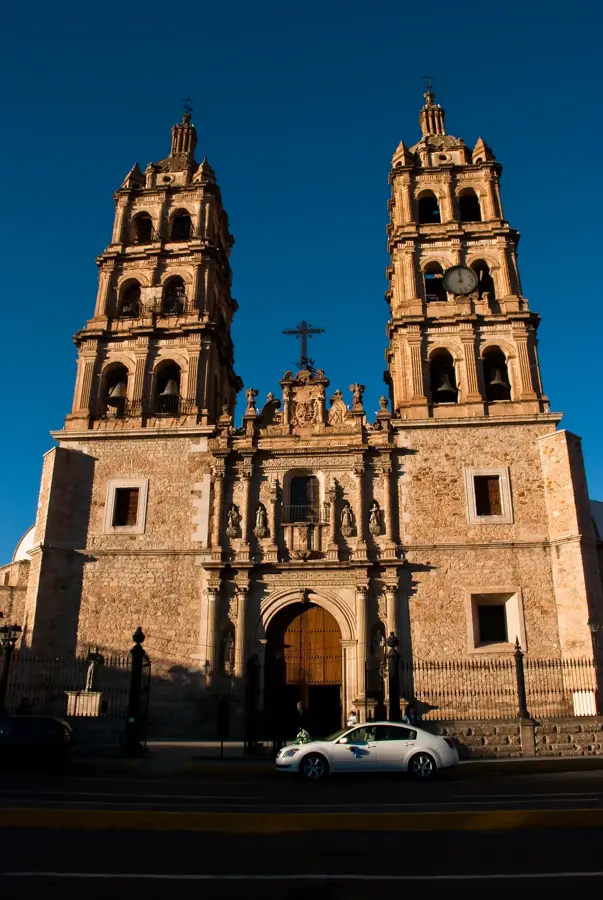
Victoria de Durango, the capital of the state of Durango, is a city steeped in colonial history and cinematic legend, located in the fertile Guadiana Valley of northern Mexico. Founded in 1563 by Francisco de Ibarra, the city served as a vital administrative and mining center during the Spanish era, fueled by the massive iron ore deposits of the nearby Cerro del Mercado. Its historic center is a masterpiece of urban planning, featuring one of the most significant collections of Baroque and Neoclassical architecture in the country, which earned it a spot on the UNESCO World Heritage list as part of the Camino Real de Tierra Adentro. The Cathedral Basilica of Durango stands as a testament to this era, with its grand facade and ornate interior. In the mid-20th century, Durango became internationally famous as the "Hollywood of Mexico" due to its rugged landscapes and well-preserved colonial streets, which served as the backdrop for hundreds of Western films starring icons like John Wayne and Clint Eastwood. Today, visitors can still explore movie sets like Villa del Oeste, which preserve this unique heritage. Economically, Durango has evolved into a diversified hub, with a strong focus on mining, forestry, metallurgy, and a growing aerospace sector. The city is also a major educational center, home to the Juárez University of the State of Durango, which fosters an animated cultural and intellectual environment. Geographically, Durango is surrounded by remarkable natural beauty, including the canyons of the Sierra Madre Occidental and the unique rock formations of Mexiquillo, making it a growing destination for ecotourism and outdoor adventure. The city's climate is semi-arid, with sunny days and cool nights characteristic of its 6,200-foot elevation. Local culture is celebrated through the Durango National Fair, a month-long event showcasing the state’s agricultural, industrial, and artistic achievements. The local cuisine is distinct, featuring dishes like Caldillo Durangueño and the renowned Durango cheese. Victoria de Durango remains a vital link between Mexico’s colonial past and its industrial future, offering a high quality of life and a rich cultural tapestry.
- Location: Mexico
- Top sights: Monumento de piedra · Museo de Arte Funerario Benigno Montoya · Monumento a Luis Donaldo Colosio
- Nearby: Durango (16 km)
- Population: ~518.709 (2025)
Best time to visit & climate
The most pleasant time to visit is Apr–Jun.
| Jan | Feb | Mar | Apr | May | Jun | Jul | Aug | Sep | Oct | Nov | Dec | |
|---|---|---|---|---|---|---|---|---|---|---|---|---|
| Avg °C | 10 | 12 | 15 | 18 | 21 | 23 | 21 | 21 | 19 | 17 | 13 | 11 |
| Rain mm | 11 | 14 | 7 | 2 | 8 | 61 | 136 | 125 | 131 | 32 | 18 | 7 |
Geography
Facts
- Durango was founded in 1563 and is named after the Basque town of Durango.
- The city’s historic center was declared a UNESCO World Heritage site in 2010.
- Durango sits at an elevation of 6,200 feet (1,890 meters) above sea level.
- More than 150 feature films, mostly Westerns, have been shot in Durango since 1954.
- Cerro del Mercado is a major source of iron ore, active since the colonial era.
- The city is the birthplace of legendary actress Dolores del Río.
- Durango’s Cathedral features a unique collection of colonial-era sacred art.
- The city is a key stop on the historic 'Silver Route' from Mexico City to Santa Fe.
Explore nearby
Notable places around
Route planner — Car & Motorhome
Where do you start? We build the route here, with stops and country notes along the way.
© OpenStreetMap contributors · OpenRouteService
We start our day delving deep into the city's roots at the Tunel de Minería. As noon approaches, the classic elegance of Teatro Victoria offers a glimpse into Durango's vibrant artistic past. The afternoon brings us outside to admire the patriotic Monumento a la Bandera and stunning city vistas from the nearby Mirador. We conclude the walk reflecting at Los Tres Durango, soaking in the late afternoon ambiance before evening falls.
Tunel de Minería
Teatro Victoria
Monumento a la Bandera
Mirador
Los Tres Durango
Morning starts underground in the mining tunnel, perfectly sheltered from the rain. At noon, the theater's grand interior provides a dry cultural escape. In the afternoon, head to the monument with a sturdy umbrella for a misty view of the city. The evening concludes under the historic downtown arches, watching the city lights shimmer on the wet cobblestones.
Tunel de Minería
Teatro Victoria
Monumento a la Bandera
Mirador
Los Tres Durango
The crisp winter morning starts refreshingly in the tunnel, where the temperature stays constant. At noon, we warm up inside the magnificent theater. In the afternoon, we take advantage of the bright winter sun at the monument before darkness falls quickly around 5 PM. The evening ends in the cool but festively lit old town, wrapped in layers.
Tunel de Minería
Teatro Victoria
Monumento a la Bandera
Mirador
Los Tres Durango
We set off on our bicycles through the serene, statue-lined paths of the Museo de Arte Funerario. Before noon, we delve into the earth at the Tunel de Minería, a fascinating contrast to the open skies. The afternoon ride takes us past majestic historical monuments, leading up to the lively and green Zologico Guadiana. We end our energetic day at the Museo Bebeleche, dismounting to enjoy some interactive fun as the sun goes down.
Museo de Arte Funerario Benigno Montoya
Tunel de Minería
Monumento al Gral. Gpe. Victoria
450 aniversario
Zologico Guadiana
Museo Bebeleche
Despite the rain, we start the tour in the sheltered cemetery museum. At noon, the mining tunnel offers a dry passage beneath the city. In the afternoon, we cycle carefully on wet paths through the park to the zoo. The day ends at the Bebeleche Museum, staying indoors and drying our gear while exploring the world of science.
Museo de Arte Funerario Benigno Montoya
Tunel de Minería
Monumento al Gral. Gpe. Victoria
450 aniversario
Zologico Guadiana
Museo Bebeleche
The winter tour requires warm gloves against the cool headwind. In the morning, we explore the quiet cemetery. At noon, the tunnel offers a welcome warming break. In the afternoon, we use the last daylight in the park before reaching the Bebeleche Museum at 5 PM. The day ends there in the warmth, just as darkness falls early over Durango.
Museo de Arte Funerario Benigno Montoya
Tunel de Minería
Monumento al Gral. Gpe. Victoria
450 aniversario
Zologico Guadiana
Museo Bebeleche
We start our driving adventure with a quiet reflection at the ancient Monumento de piedra, setting a historical tone for the day. Continuing our journey, the intricate funerary art of Benigno Montoya offers a breathtaking juxtaposition of life and art before the midday heat. The afternoon drive sweeps past prominent memorials and the striking modern architecture of Teatro Durango, blending eras of city growth. We conclude by marveling at the colossal Monumental Flag and unwinding at the interactive Museo Bebeleche as dusk approaches.
Monumento de piedra
Museo de Arte Funerario Benigno Montoya
Monumento a Luis Donaldo Colosio
Teatro Durango
Monumental Flag
Museo Bebeleche
By car, we explore Durango comfortably and dryly despite the rain. In the morning, we visit monuments and museums without getting soaked. At noon, the theater offers an excellent cultural stop. In the afternoon, we drive to the Bebeleche Museum, the best indoor spot for rainy days. The evening ends relaxingly, watching the lit city through the rain-streaked windows.
Monumento de piedra
Museo de Arte Funerario Benigno Montoya
Monumento a Luis Donaldo Colosio
Teatro Durango
Monumental Flag
Museo Bebeleche
In a heated car, we enjoy Durango's winter highlights. In the morning, we visit the quiet Montoya cemetery. At noon, we warm up with cultural stops. In the afternoon, we take advantage of the brilliant light at the monuments before the sun sets at 5 PM. The evening at the Bebeleche Museum provides a cozy, warm end to the day in a modern setting.
Monumento de piedra
Museo de Arte Funerario Benigno Montoya
Monumento a Luis Donaldo Colosio
Teatro Durango
Monumental Flag
Museo Bebeleche
Sights in the town Victoria de Durango (17)
Frequently asked questions
What characterizes Durango?
What is the best travel time?
How long does a visit take?
Are there family activities?
What must you see?
Victoria de Durango: where is it located?
Victoria de Durango: what is there to see?
Victoria de Durango: when is the best time to visit?
Victoria de Durango: why is it worth visiting?